Note: I am changing the country sequence because I heard from friends who said I should mix it up to keep it more interesting (i.e. not just focus on high fertility countries in one quarter and so on). So, I am going to pair countries on demographic indicators, on opposite (ish) ends of the spectrum. Makes sense? No? Keep reading (but also revisit my updated initial post).
One of the things that people think demographers know off the top of their heads are random population facts. What’s the fourth most populous city in the world? What’s the fastest urbanizing city in the world? What’s the smallest country in the world? The answer to all those is - irritatingly - itdepends (on how you measure it). Importantly, I think even my educated guesses could be wrong.
Thanks for reading Demography Matters! Subscribe for free to receive new posts and support my work.
Last week, we focused on Niger and its median age (lowest in the world currently), so naturally, this week we would look at a country with the highest median age in the world. I was so ready to dive into one of my favorite cuisines, Japanese (droool), but imagine my surprise when it turned out to be, well, Monaco. Listen, I enjoyed Netflix’s Murder in Monaco as much as any real crime documentary watcher, follow Formula 1 to the extent that it is newsworthy, and know it as a tax haven for the rich. But the demography of Monaco? Not something I can confidently say I know much about.
So what better chance to do just that?
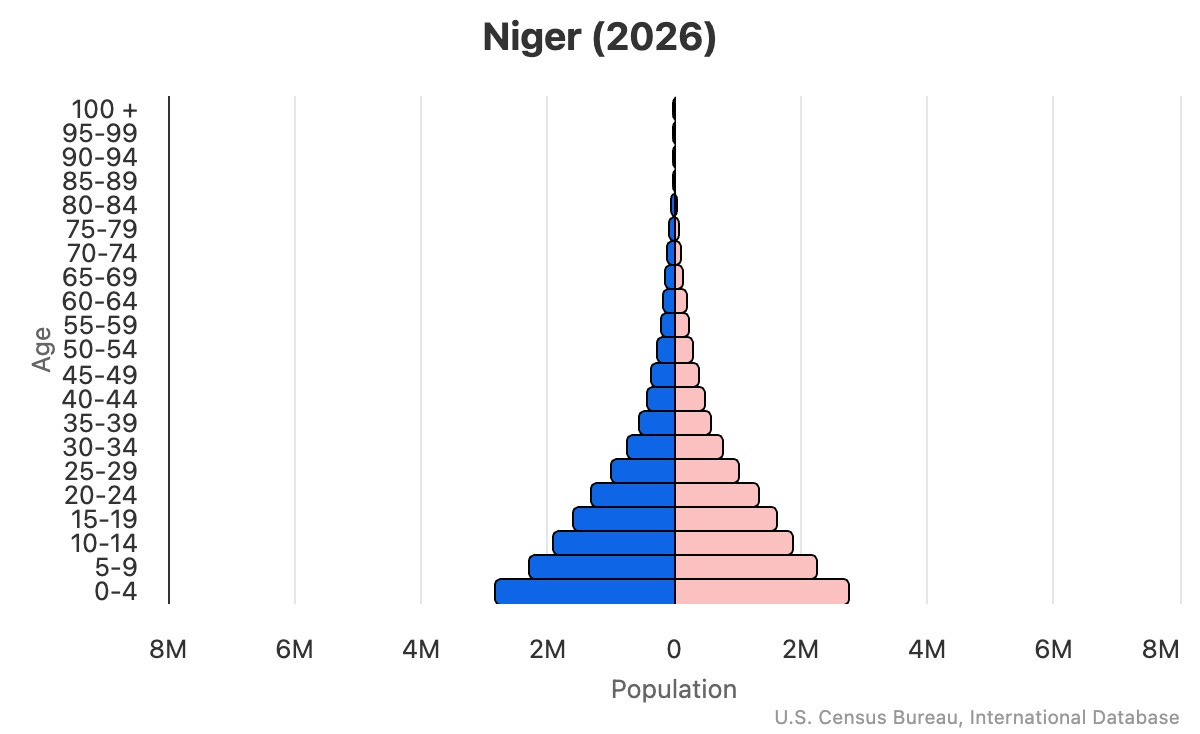
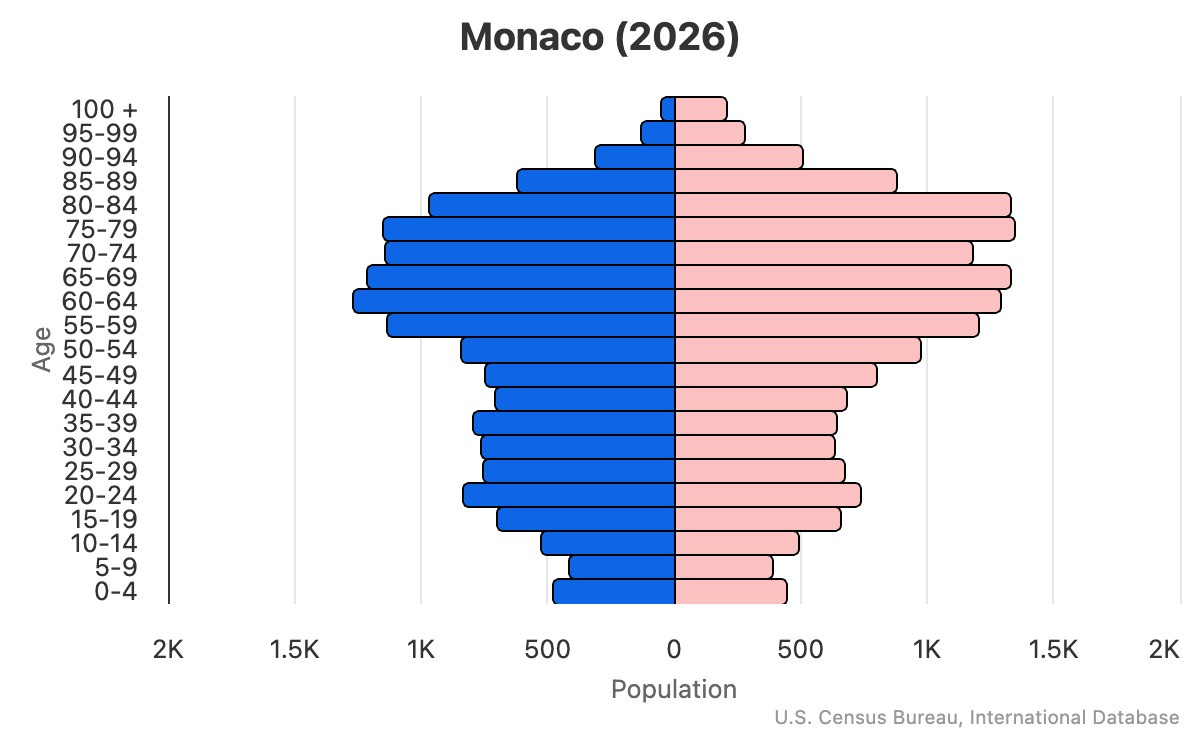
If you recall, about half of Niger’s population is under the age of 15. Half of Monaco’s is over 55. If Niger’s median age is 15.4, Monaco’s is a whopping 58.2. Population pyramids are a great way to visualize this polarity (males on the left, females on the right) below. Niger and Monaco are basically inverted.
For more information on how to interpret population pyramids, check this out. In short, A population pyramid functions as a demographic fingerprint, plotting age cohorts by sex to reveal a country’s history and future trajectory. To interpret one effectively, look at three key areas:
The Base: A wide base indicates high fertility and growth, while a narrow base suggests a “graying” population with birth rates below replacement level.
The Slope: Straight, vertical sides reflect high survivorship into old age, whereas steep, inward-curving sides indicate high mortality rates across younger age groups.
Anomalies: Look for “bulges” (representing baby booms or labor migration) and “indents” (signifying historical shocks like war, famine, or epidemics).
Essentially, the pyramid’s shape tells you whether a society is expansive (young and growing), stationary (stable), or constrictive (aging and shrinking).
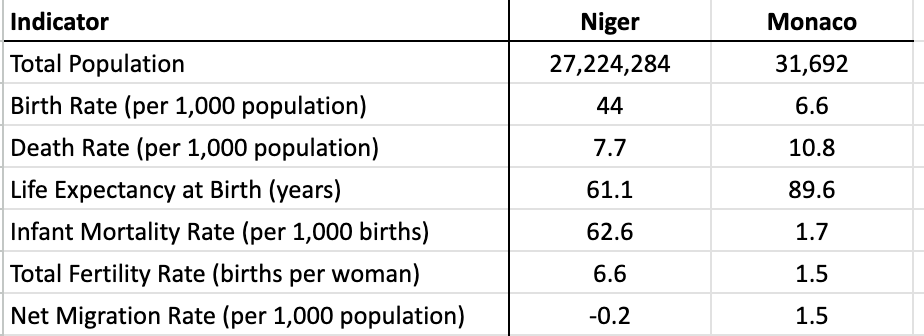
To compare some quick facts about both countries, see below:
But what does any of this actually mean?
To me, there are two aspects that stand out. The first is the care economy, and the other is the commuter economy - both of which underline the necessity of immigration for the Principality.
Care Economy
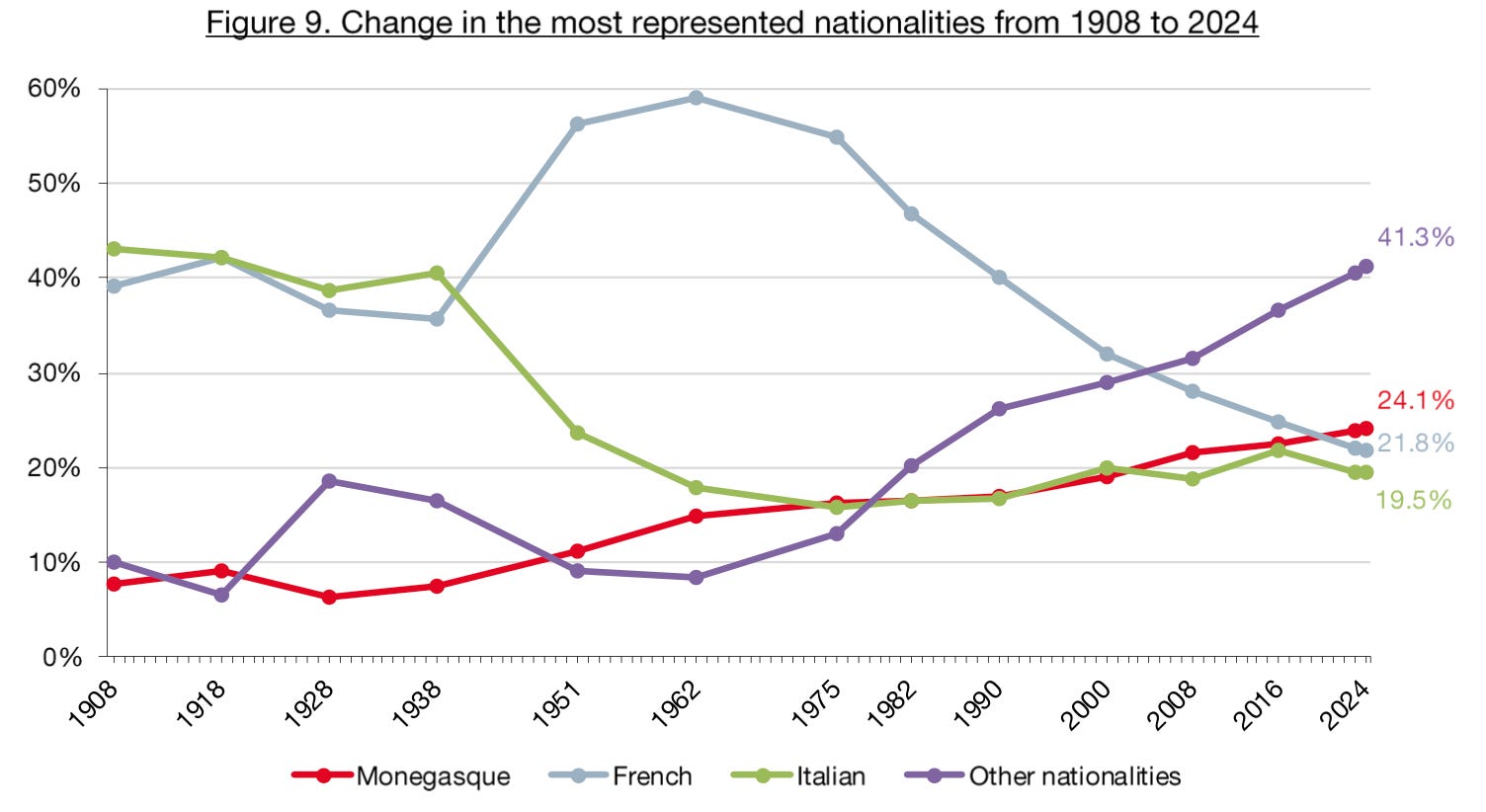
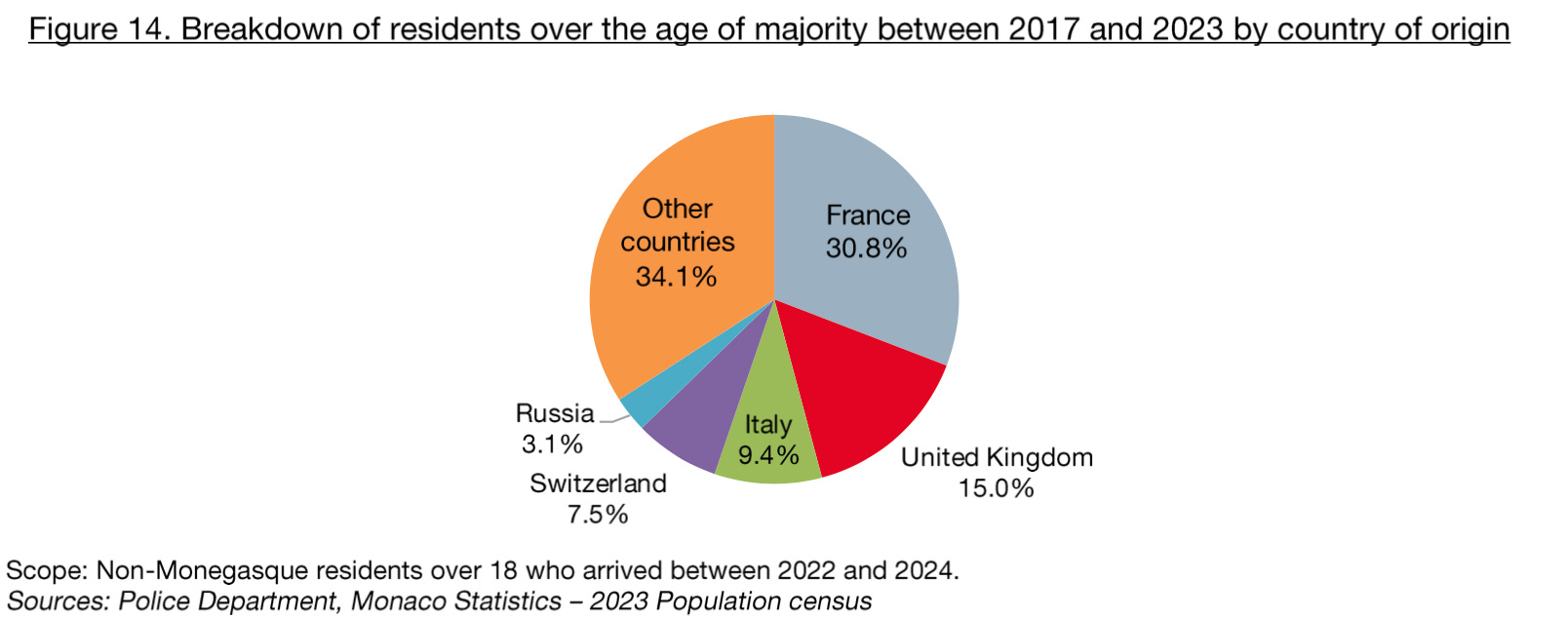
In Niger, as we discussed, your family are your social security, so it is no surprise that household sizes are large, with recent UN estimates placing it as about 5.9 persons on average per household. That’s almost 3x the average household size in Monaco, which sits at 2.1. Add to that, the fact that about 75% of Monaco residents are not native Monegasque (i.e. moved in their adulthood for work or later during retirement, with citizenship notoriously difficult to obtain) - there is a real need to import labor, particularly related to the care economy (elder care, healthcare, domestic services, education, hospitality etc.) If you look at the graph below, from 1980 onwards, nationalities other than French/Italian/Monegasque started to increase as a proportion of the population. The pie chart expands on this breakdown, focusing on the recent time period (2017-2023.)
With an influx of global care workers to care for the global elite in Monaco, there is bound to be tension (which we will explore in other countries later in the series dealing with right wing populism.)
With an impressive life expectancy at 89.6 years, people in Monaco are not only living longer lives, these lives are - for the most part- healthy. The Compression of Morbidity theory (Fries, 1980s) states that as people live longer, the period of chronic illness and disability (morbidity) at the end of life can be squeezed into a much shorter time frame, leading to longer, healthier lives with a "rectangular" survival curve, rather than prolonged frailty (thank you, mediterranean diet? maybe, but “no” says my favorite health podcast, Maintenance Phase. I digress.)
In countries like Monaco, residents stay healthy for decades and then experience a rapid decline only at the very end. Even with this “compressed” illness, a super-aging society requires a massive, professionalized workforce to manage what researchers call healthy lifespan inequality—the increasing unpredictability of when health begins to fail. Monaco has responded by building a specialized industry of preventative gerontology. Some examples include:
Nighttime Mobile Caregivers: The “Night Traveling Guard” provides safety checks and medication support, essentially replacing the unpaid labor of the large families and social structures you see in Niger.
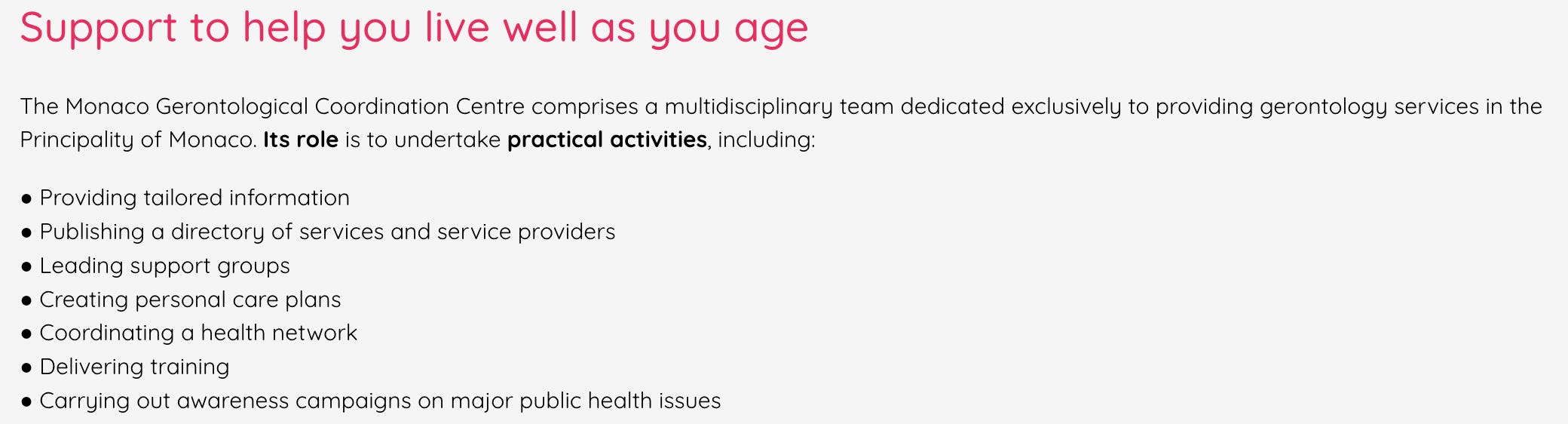
Gerontological Coordination Centre (CCGM): A multidisciplinary team that creates personal care plans and health networks to support aging in place, including an emphasis on social support.
A tiny principality like Monaco is unable to sustain itself and certainly needs help when it comes to the labor pool. The 2024 Census finds that Monegasque companies and administrations employ over 65,000 people (double the resident population!) the majority of whom live outside the Principality.
Monaco benefits from these workers but does not actually invest in “producing” them or caring for their dependents. More on that later.
How many commuters? Only about 10% of employees in Monaco actually live there, which means the rest are commuters. (the traffic!) The city of Nice alone provides over 16,000 workers.
Labor Force Participation: For those residents who do work, the salaried employment rate is just 36.5%, as many residents are retired, ultra-wealthy, or self-employed.
Who gets to belong?
This system creates a tiered hierarchy of social benefits and healthcare where not everyone benefits from the state. Again from the Census:
Monegasque Citizens (24.1% of pop): The privileged 9,262 people who hold citizenship. They have full access to gilded state-funded insurance (Caisses Sociales de Monaco) and priority for state-owned housing (which makes up 19.2% of the total units).
Foreign Residents: Most move in adulthood for work or retirement. To stay in the bubble, non-Monegasque adults (roughly 64.5% of the pop) must prove financial means and maintain private insurance.
Commuters: They are covered by compulsory public insurance (CCS) based on their employment but do not have full access to the citizen-only state funds. They enjoy higher net pay than in France (thanks to lower social charges), but they are physically excluded from residency by real estate prices and general cost of living.
Ultimately, Monaco is kind of like a high-tech and well funded laboratory for a new kind of existence (for a privileged few). One where the traditional “family as social security” model we saw in Niger is replaced by a professionalized care industry by means of a daily injection from across the border. The Principality has optimized out the messy (and expensive) parts of the life cycle to other countries. Perhaps this is simplifying things too much, but it proves that if you don’t actually grow your future, you can just lease it from others and hope you have a good podcast companion for morning traffic.
Final Note on the Census data: Most countries in the Global South conduct censuses every 10 years barring security concerns, elections, or pandemics. These are door-to-door operations that are logistically complicated and expensive, still regarded as the gold standard while innovative alternatives using satellite imagery are refined. Countries like Monaco have population registers which collate information from a variety of existing databases - Civil Status and Nationality Department of Monaco City Hall, Police Department, Department of Education, Youth and Sport, Department of Forward Studies, Urban Planning and Mobility and State Property Authority - so that census results can be tallied annually instead of 8-10 years apart. Pretty cool.
The Food!
We made Pissaladière (a cross between a pizza and a tart; I reproduced the recipe below since it is behind a paywall) and a seafood salad (we didn’t have all the things, so substituted tinned fish (squid, mussels) and fresh shrimp). Both of these dishes were SO good! I didn’t know I needed copious amounts of caramelized onions and anchovies together in my life until this moment.
Kimaya made yet another presentation (which included singing the national anthem), and Eymir went into (too much) detail about their soccer team’s history and famous players (loosely Mbappe and Thierry Henry). We listened to music from Princess Stephanie and were glad that era of music is over.
¼ cup Niçoise olives, pitted or not, or to taste (we sliced them)
For the Dough (Yes! I made dough!)
1½ teaspoons active dry yeast
⅔ cup warm water
3 tablespoons olive oil
2 cups/250 grams all-purpose flour
1½ teaspoons fine sea salt
Preparation
Step 1
Make the filling: Finely chop 2 of the anchovy fillets. Heat oil in a large skillet over medium heat. Add onions, garlic, thyme and chopped anchovy, then cover pan and cook, stirring occasionally, for 20 minutes. Reduce heat to medium-low, stir in salt, and continue cooking for 25 minutes, stirring occasionally. The onions should be pale golden and very soft; lower the heat if they start to turn dark brown at the edges or stick to the skillet. Use your judgment on timing: Look to the color of the onions to tell you when they’re done. Remove from heat and cool completely before using.
Step 2
Meanwhile, make the dough: In a medium bowl, sprinkle dry yeast over warm water. Let stand until foamy, about 5 minutes, then add oil. In a large bowl, whisk together flour and salt, then stir in yeast mixture with a wooden spoon until combined. Turn bowl’s contents out onto a floured surface and knead until uniform and elastic, 3 to 5 minutes. (Flour your hands if necessary to keep dough from sticking.) Transfer dough to an oiled bowl, flip the dough over, cover bowl with a damp cloth and let rest in a draft-free place for 1 hour.
Step 3
Lightly oil an 11x17-inch rimmed baking sheet. Working on a floured surface, roll dough into an 11x16-inch rectangle, then transfer it to the oiled baking sheet and press the dough to the sides. Cover with a damp cloth and let rest for 30 minutes.
Step 4
Heat the oven to 400 degrees. Spread cooked onions evenly over dough, and top with remaining anchovies and olives. Bake until edges and underside are golden brown, 20 to 25 minutes. Serve warm or at room temperature.
Thanks for reading Demography Matters! Subscribe for free to receive new posts and support my work.
This update is already a step up from your first one! I'm loving your style. Also, it's so good to see Kimaya and Eymir take this up so seriously. How do you pick the music though?




This update is already a step up from your first one! I'm loving your style. Also, it's so good to see Kimaya and Eymir take this up so seriously. How do you pick the music though?
I’m loving this series!