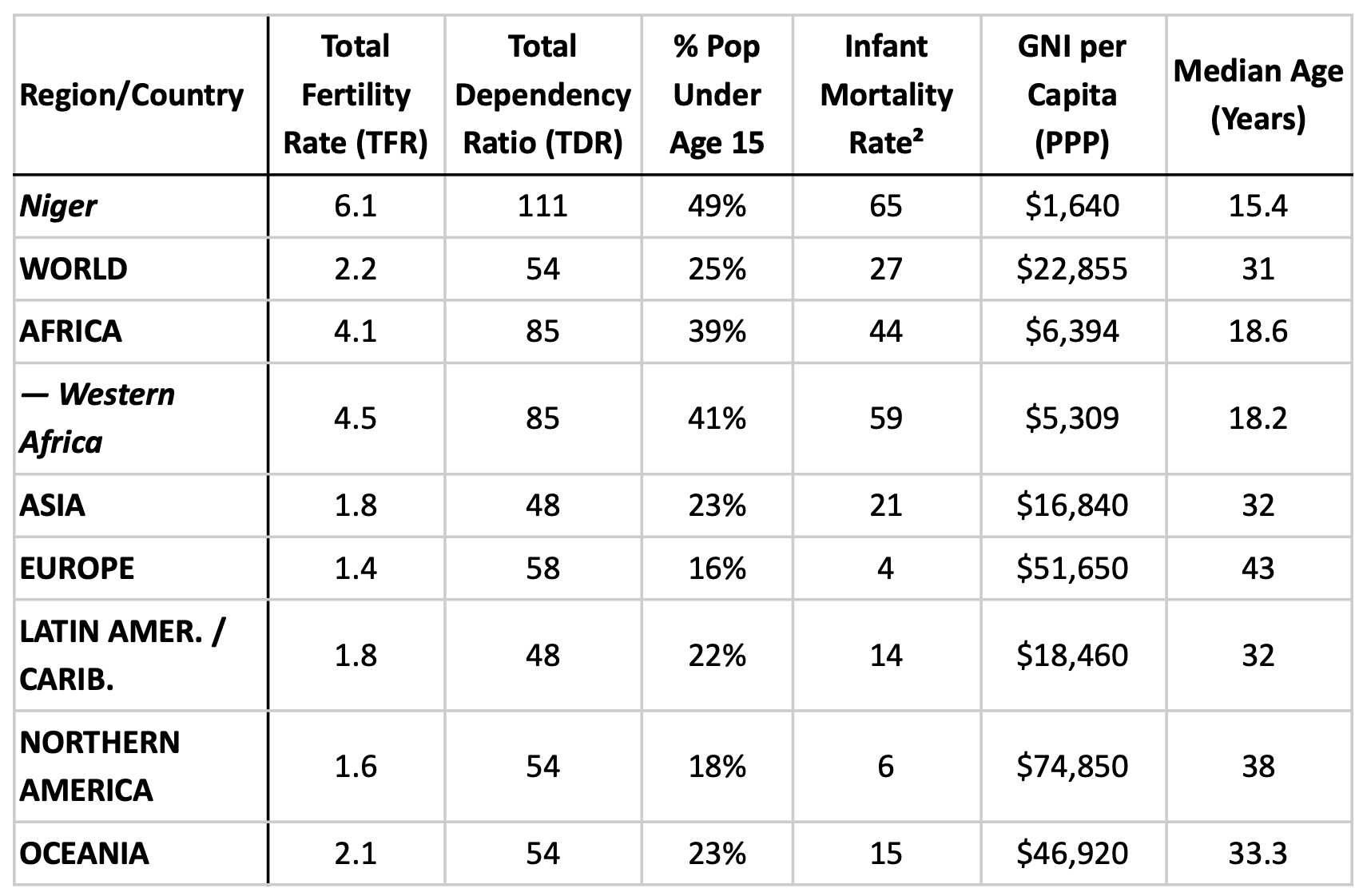
Niger made sense as a kick-off country for reasons that are obvious to demographers, but likely not to many others. It is the global frontier of population trends—the youngest country in the world, the most fertile country in the world, has the highest age-dependency ratio in the world and so on. To put that in perspective, Niger isn’t just an outlier compared to the West; it is an outlier even within its own neighborhood.
Amidst so much screaming about population decline and alarmism, starting out with countries that are at the “high fertility” end of the spectrum is frankly refreshing and potentially instructive.
Demographer Alex Ezeh gave a powerful talk at USAID a few years ago where he articulated that Niger, with a growth rate of 3.3%, has a population that is expected to double every 20 years. Considering the already dismal statistics around infrastructure, healthcare, and education in the country now, the levels of investment needed to just keep pace at that level of population growth is mind-boggling.
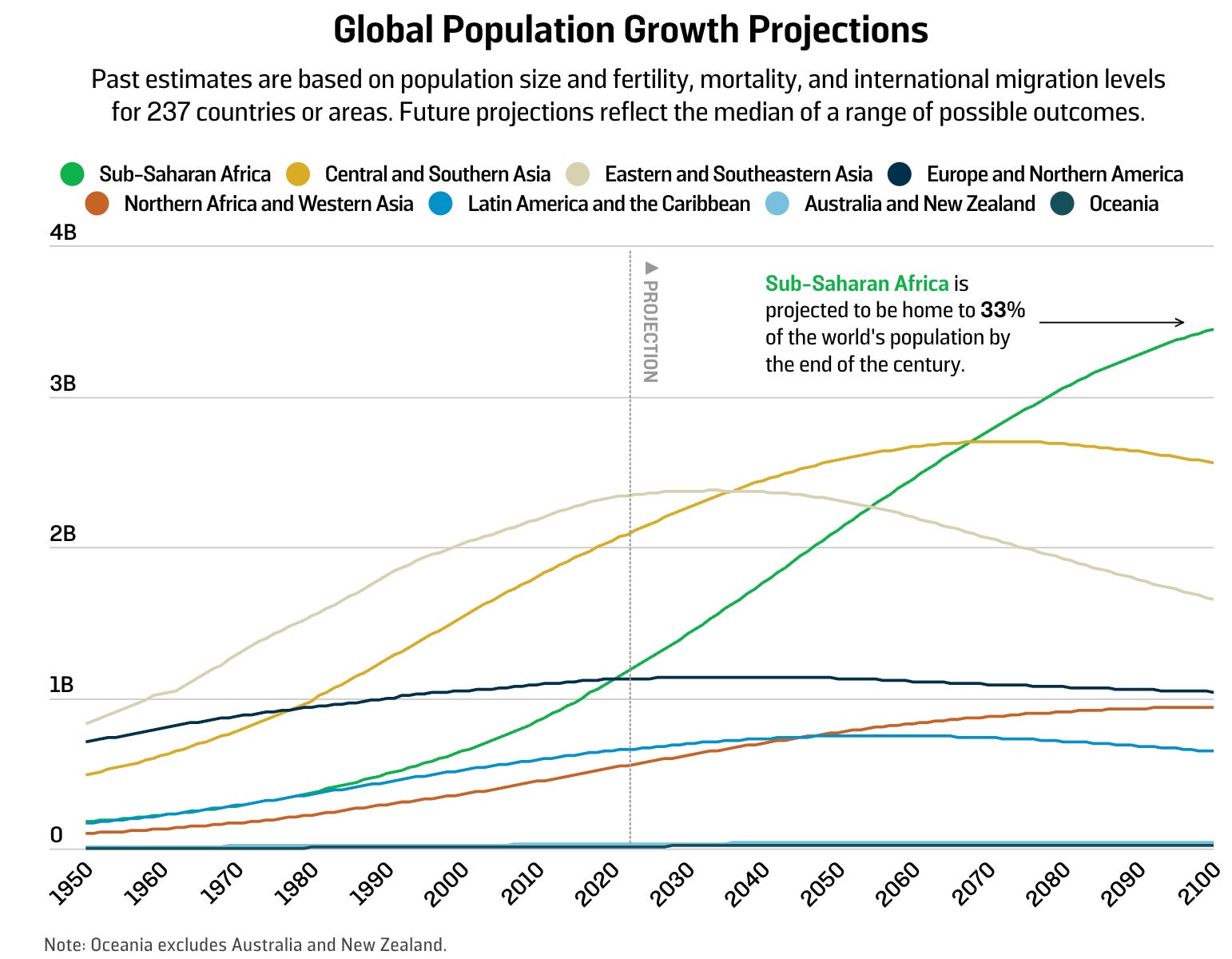
In his (excellent, highly recommend) recent-ish book Youthquake, Edward Paice argues that African population growth should not be viewed through the outdated lens simply of a “population explosion,” but really a seismic shift with ripple effects far beyond population numbers. That said, the data (and what it means) is staggering: By 2050, Africa will account for 25% of the world’s population, rising to 33% by 2100. I return to this graphic from Foreign Policy because of its simplicity in articulating this statistic:
What does this really mean?
Its [Africa’s] population is projected to grow from 1.5 billion in 2024 to 2.4 billion in 2050, accounting for over 60% of projected global population growth during the same period. As fertility declines from high to low levels, the share of the young dependent population will decline relative to those in the working ages. With a higher proportion of wage earners and fewer dependents to support, countries can enter a window of opportunity for sustained economic growth—or a demographic dividend. - PRB’s World Data sheet
Getting to the demographic dividend however, is not a given.
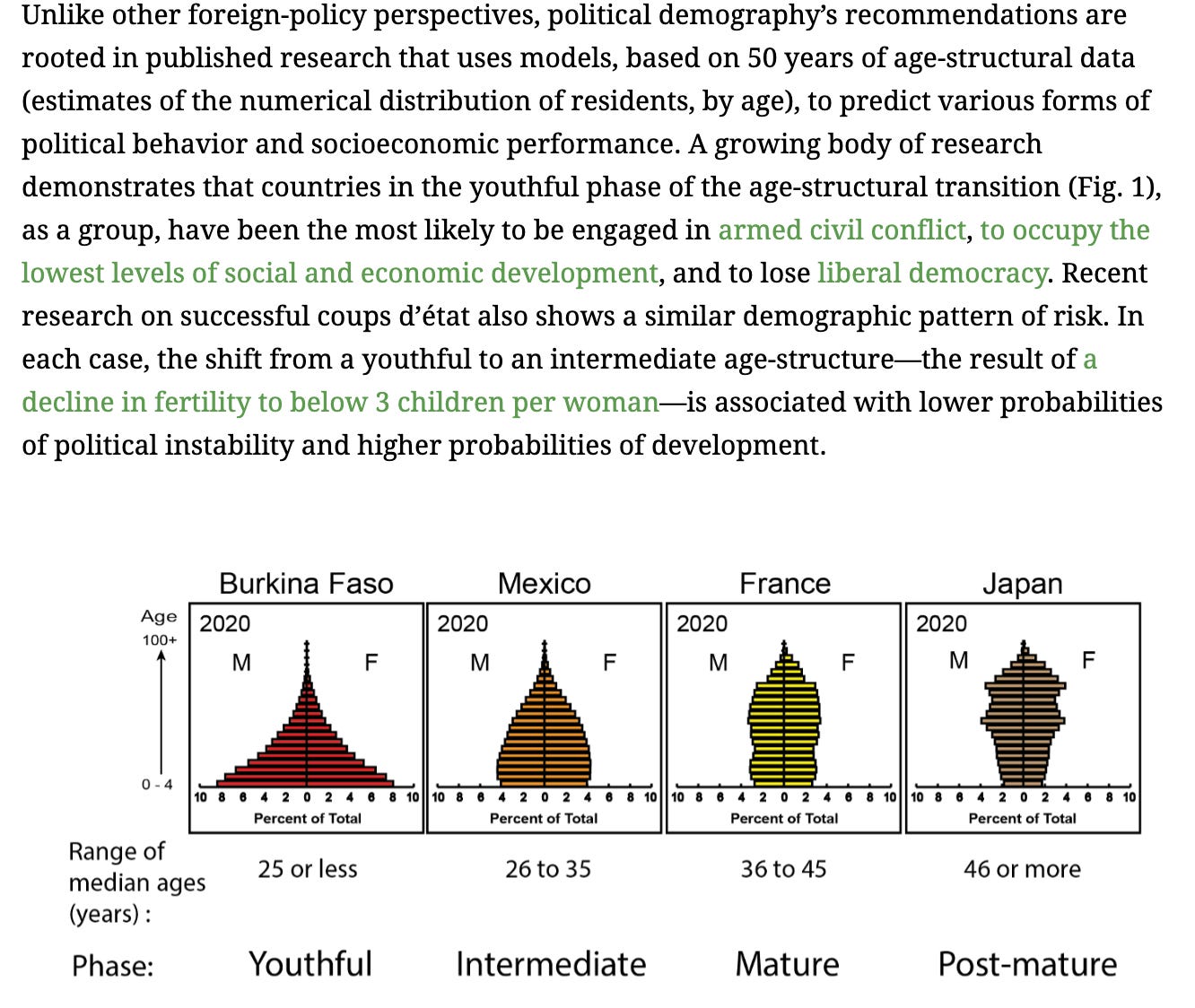
Political demographer Rich Cincotta, who pioneered the Age-Structural Theory of State Behavior, views a country’s demographic maturity one of the best predictors of its stability. His research suggests that liberal democracies rarely survive until the median age reaches at least 25 to 30 years. With Niger at 15.4, Cincotta’s work likely places the country in a high-risk category for authoritarianism and civil conflict. If the state cannot provide education and jobs for this wave of youth, they risk not only losing sight of a demographic dividend, but worse.
An additional perspective to the why behind high fertility has been offered by social scientists for decades (Caldwells in the 1980s, certainly others earlier and later). Scholars have argued that high fertility in Niger and other countries is not irrational or an accident of development. Rather, it is a rational survival strategy in a context of high child mortality and low economic security. Indeed, according to the Demographic and Health Survey Program (DHS), the “ideal family size” in Niger remains one of the highest in the world—often exceeding 9 children (specifically, 9.2 as reported by women and 10.9 reported by men). What we see in Niger then is that the ideal family size is actually higher than actual fertility rates. This is confirmed by the relatively much lower prevalence of contraception, with unmet need for family planning at 16%. [Note: I recognize these data are quite old, and perhaps will be for a while but that’s the best I could find.]
These aren’t just personal preferences; they are injunctive norms, i.e. the social pressure to conform to community expectations. In Niger (and many other countries), patrilineal traditions dictate that a large family is essential for lineage survival and community standing. This is further cemented by the prevalence of early marriage; 76.% of women aged 18–22 were married before age 18 and 25% before age 15. This effectively maximizes the reproductive window, ensuring that the “ideal” family size can get close to the “actual.”
To that end, there are levers that could make a monumental difference. Ezeh points out that changing the timing of births may make a huge difference. He finds that simply delaying the age of first birth by two years across the continent could reduce the projected 2100 population by 10%.
Consider this thought experiment. If every woman started having children at age 15, then in 60 years you’d have four generations (60/15=4). But if every woman started having children at age 20, then in 60 years you’d have three generations (60/20=3). Even if those women had the same number of children in each generation, the total population would be one-quarter smaller in the latter scenario. To be conservative, we assumed a less substantial delay in our model. Still, it changes the projected population by nearly 10%.
Finally, Niger is caught in a dependency ratio where 100 workers support about 111 dependents (defined here as those between the ages of 0-14 and 65+, check out the chart at the very top), it is nearly impossible for the state to invest sufficiently in the education and health of each child, not to mention the dramatic cuts to foreign aid (not just from the US) that further impacts any progress. Niger’s demographic dividend remains locked behind this wall of high dependency. Until the birth rate slows, many think that the “youthquake” remains a fiscal burden rather than an economic engine. From what scientists like Cincotta claim, this matters not just for Niger, but also for the world. Hat tip to Julianne Weis for sharing this relevant update.
We often want demography to be simple: a math problem to be solved with better inputs. But as this piece shows (if you have read this far - congrats and hello to my parents), the reality is a complex web of cultural norms, survival strategies, and political stability (and I didn’t even get into other complexities like migration, climate change and more.) Niger stands at a crossroads where the internal logic of the family sits in direct tension with the fiscal logic of the state. Resolving that tension is perhaps the greatest development challenge of our time.
Disclaimer: I do not claim to be an actual domain expert on any of the countries I am writing about. Instead, I am trying to read, learn, and interpret as much as I can. I will get it wrong sometimes, and I would love to hear from you if so. Demography may not be destiny, but growth through debate certainly can be :)
Note on data sources: Much ink has been spilled on the methodologies underlying population projections from the UN, US Census Bureau, and IHME among the main players. I will jump around on data sources I will use based on availability and convenience (as I hammer this out in between life and work). If you have no idea what I am talking about, you can consider yourself lucky and/or read this Vox article for the particulars.
Now, for the food! We made Djerma Stew and used more or less the recipe linked (but tripled the garlic, duh). My son researched that there is such a thing as a Nigersaurus, my daughter did a whole cutie pie research project, and we danced around to music by Bombino. If you are curious (as we were) about the history of peanuts since peanut butter is a star ingredient, check out this illuminating history of the peanut and how it made its way to Africa and African cuisine.
Thanks for reading Demography Matters! Subscribe for free to receive new posts and support my work.
Fun stuff! You know, I attended a presentation that Rich Cincotta did at the Wilson Center waaay back when I first joined USAID. And after being terminated last year, I ditched a lot of my library...but not "The Security Demographic". I kept that for my office at home. I still open it up on occasion as it was a seminal piece on the link between demographic indicators and predicting state failure.
Apoorva, this is amazing (as I totally expected!). You made complex ideas super approachable and also made me really hungry at the same time. I look forward to sharing this with friends, colleagues, and my own dad, who sits at this "demography table" not from the public health expert side, but from the chef side. Can't wait to read more!!




Fun stuff! You know, I attended a presentation that Rich Cincotta did at the Wilson Center waaay back when I first joined USAID. And after being terminated last year, I ditched a lot of my library...but not "The Security Demographic". I kept that for my office at home. I still open it up on occasion as it was a seminal piece on the link between demographic indicators and predicting state failure.
Apoorva, this is amazing (as I totally expected!). You made complex ideas super approachable and also made me really hungry at the same time. I look forward to sharing this with friends, colleagues, and my own dad, who sits at this "demography table" not from the public health expert side, but from the chef side. Can't wait to read more!!