

Last week, in the exploration of Nepal, I started off by showing how marriage is on the decline worldwide. It is most evident in Europe and North America with a drop from 1990 (64%) to now (51%). Spain stands out in Europe with one of the lowest percentages of women 15-49 that are married (below). If you are puzzled over that projected increase in marriage after say 2035, do you want to guess what’s happening? Essentially, the projection doesn’t necessarily mean the likelihood of marriage is increasing across the board. It might mean that by 2035, the cohort of 15–49-year-olds will be older, and the marriages that were postponed in previous decades will finally be statistically realized within that specific age bracket.
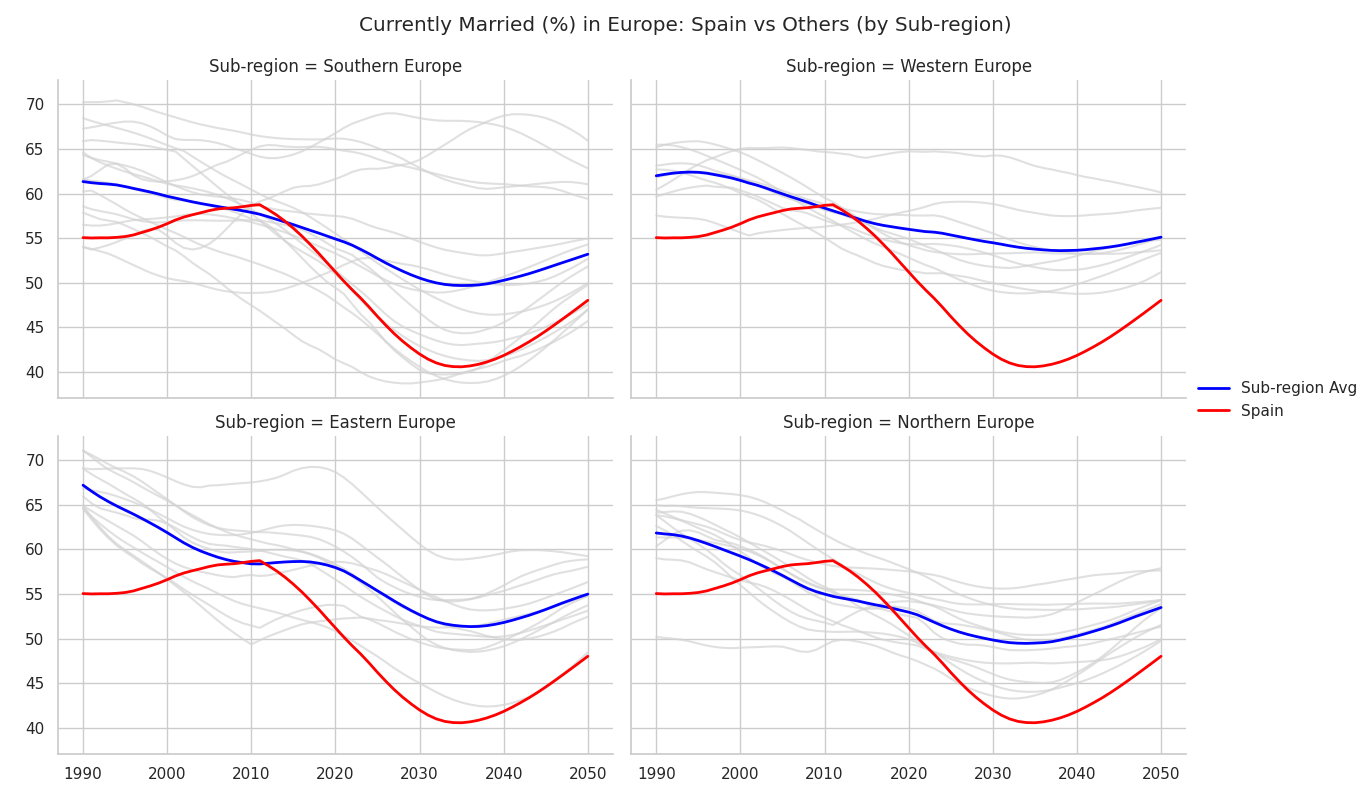
Source: Data from the UN Data Portal. Keep in mind that the UN considers “married/in-union” in their calculations, which includes cohabitation, which we know is on the rise.
This week, I wanted to look at what that decline in marriage qualitatively means for our demographic indicator in Spain: median age at first marriage. I also wanted to host a tapas party, read on.
Does this also mean that family formation is on the decline? What does it mean for other indicators of well-being? As I write this, Pope Leo XIV is on a trip to Spain, described as “...a country struggling to overcome deep polarization and political divisions, as well as a church battling a growth in secularism.” Does a decline in religion/religiosity play a role in this discussion today? Let’s find out.
Age at First Marriage in Spain
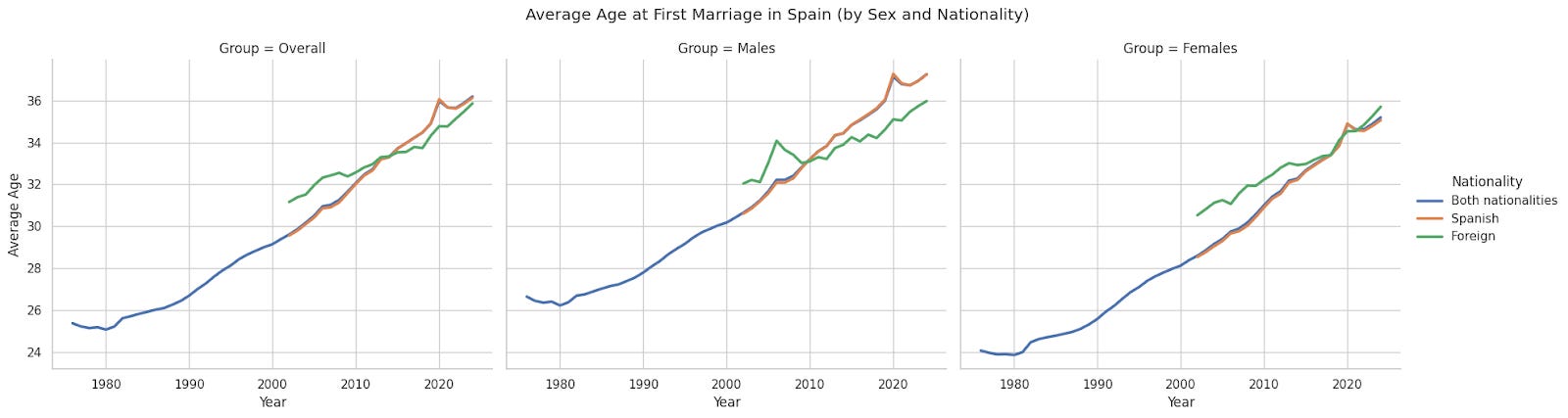
As you may have guessed, the average age at first marriage is quite high: 37 for men and 35 for women, and has increased quite rapidly, particularly in the 2000s. Migrants make up a large proportion of the population’s (50 million) growth in the last few decades, so one might think that there would be a meaningful difference in these averages by place of birth.
Source: Data from INE (2024)
In the early 2000s, foreign nationals tended to marry at older ages than Spanish nationals across both genders; likely because it was mostly men migrating first, and then marrying and bringing their wives over from their country of origin. However, in more recent years, this trend has reversed, with Spanish nationals now marrying slightly later on average. Overall though, immigrants are not marrying younger than they used to; they are delaying marriage just like the native population. Notably, the demographic composition of marriages is shifting in response to globalization and legal reforms. In 2024, marriages between individuals of the same sex (legalized in Spain in 2005) accounted for 7,336 unions, representing an 8% increase from the previous year. Simultaneously, marriages involving at least one foreign spouse saw an 8% increase, reflecting Spain’s growing reliance (and acceptance of) on immigrant populations to stabilize its demographic decline.
A report from a few years ago finds that around 50% of young and middle-aged Spaniards would never marry, and a similar percentage of Spanish marriages end in divorce. This is in sharp contrast to the situation just a few decades earlier. The cultural script was highly standardized, deeply influenced by the Catholic Church, which positioned formal marriage as the gateway to cohabitation, sexual debut, and childbearing. By the turn of the millennium, Spain was still ranked among the top five youngest marrying nations within its comparative European cohort. However, the subsequent two decades witnessed an unprecedented deceleration in family formation, possibly driven by severe economic shocks, with youth unemployment reaching as high as 50%. It appears that for modern Spaniards, the traditional institution of marriage has been delayed, redefined, or in many cases, abandoned altogether.
Parejas de hecho
One major thing that traditional demographic indicators like “age at marriage” obscures is that in some countries, like Spain, family formation is happening outside of formal marriage. In Spain, parejas de hecho or domestic partnerships (a little distinct from civil partnership) are common, and are regulated by autonomous communities rather than at the national level. I am trying to distill the rest of this piece keeping the parejas de hecho in mind, but many times the data/research does not specifically indicate whether they are talking about marriage-marriage or this type. Either way, I don’t think the substance changes much, but you can tell me if I am wrong.
Reasons for delayed (or dismissal) of marriage
A rise in religiously unaffiliated people
Perhaps the most intuitive factor behind a decline in marriage (and potentially, an increase in parejas de hecho) is the role of religion. Pew has done incredible work on the topic, and their reports/visualizations are worth your time if you are interested. If you recall, I used their data on migration quite extensively in my Mexico piece - this is just as good.
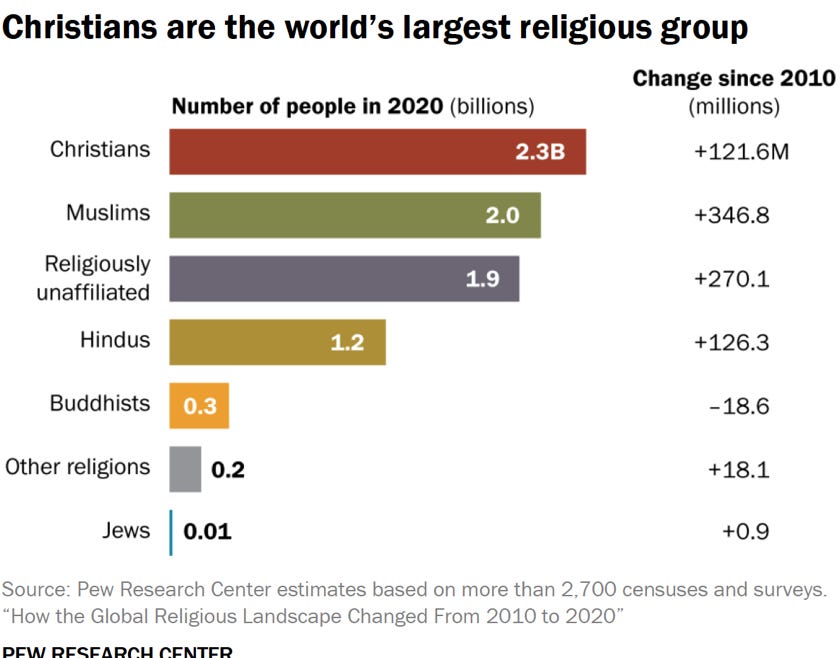
According to Pew, globally, Christians are the world’s largest religious group, with Muslims representing the fastest-growing between 2010 and 2020:
Source: The Pew Research Center (2025)
The report finds that the share of Christians shrank as a share of the population in every country save for one (Mozambique!). The second fastest-growing group is the “religiously unaffiliated,” roughly a quarter of the global population. I would love to dive into religious trends and demography, and just added that to a topic for a later post in the series. For now, I want to draw your attention to what’s happening in Spain. Between 2010 and 2020, there was a decline in the Christian population by about 9pp, and an increase of 7.5pp for the religiously unaffiliated. I am not saying that the decline in Christianity is all towards the “nones.” It could be that the Christian share of the population is shrinking due to people leaving the religion, but also aging Christian populations and low fertility.
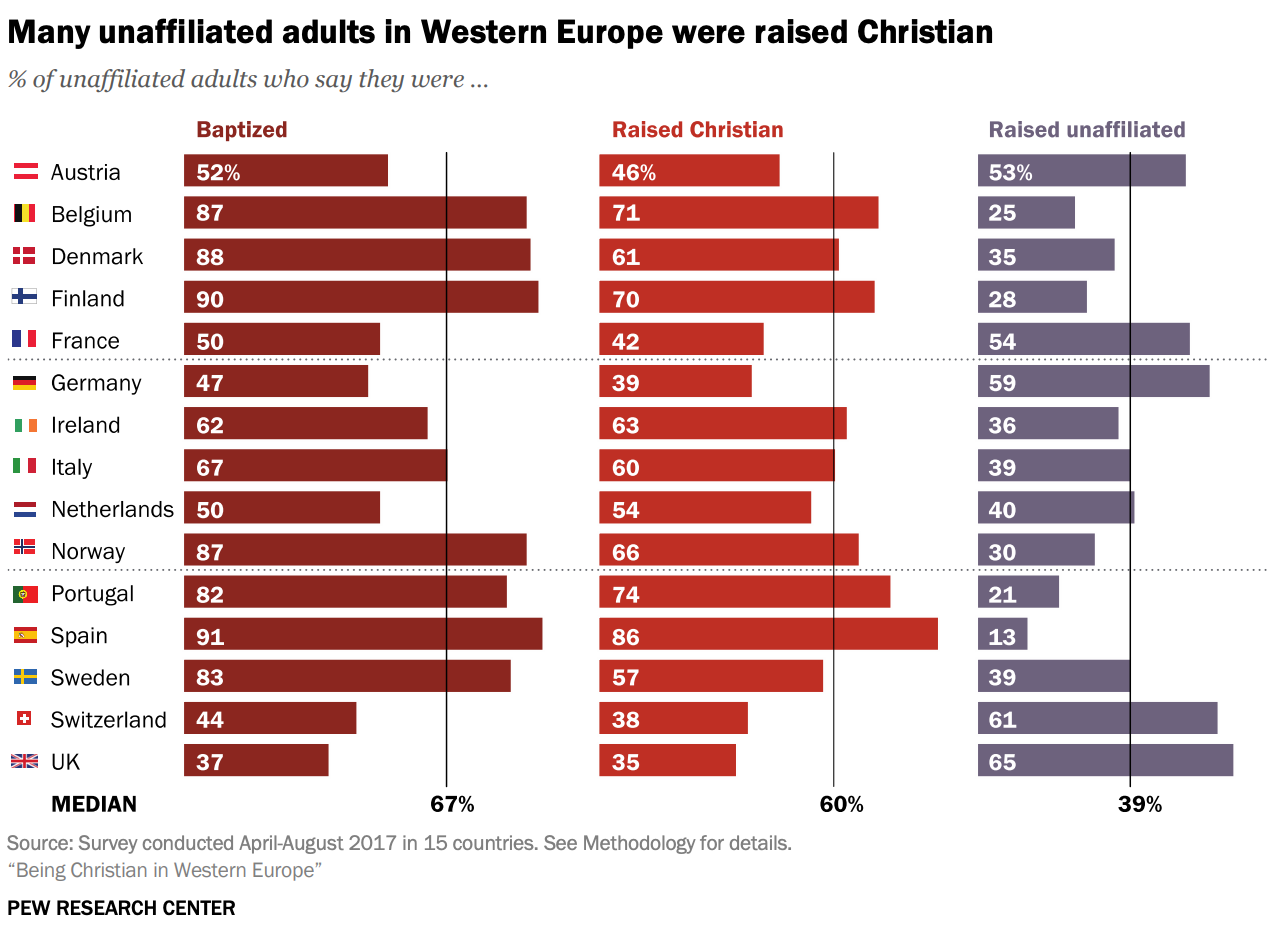
That said, there has been a generational shift away from religion that mirrors the decline in traditional church weddings. A Pew report from 2018 that focuses on Christianity in Western Europe finds that while only 5% of adults in Spain report being raised with no religion, that is now at 30%. Additionally, 86% of the currently unaffiliated Spaniards reported as being raised as Christians:
Source: Pew Research Center (2018)
This indicates an active departure from the institution rather than a gradual fading of belief, which is supported by more data that shows that about 3/4ths of adults in Spain who stopped identifying as Christian cite “scandals involving religious institutions and leaders” as an important reason for leaving. This might also explain this secular decoupling of marriage from religion. Finally, the Pew report also finds that the vast majority of both the religiously unaffiliated and “non-practicing Christians” across Western Europe strongly favor same-sex marriage and legal abortion. In fact, even among church-attending Christians in several countries, there is substantial support for same-sex marriage. This could indicate that the cultural redefinition of what makes a family has permeated almost all levels of Spanish society, regardless of religious affiliation.
Taking all this together, it looks like there are some strong cultural reasons for those who do partner, to avoid the altar, which then explains the parejas de hecho or other partnerships.
Living with your parents cramps your style (and demographic outcomes)
Speaking of avoiding the altar, weddings are not exactly cheap events and certainly not in Spain. While Spain’s top-line economic growth looks healthy on paper, the lived reality for many, including young people, is a structural squeeze that makes starting a life together financially daunting.
The fragility of the Spanish job market, characterised by a high incidence of temporary contracts and high structural unemployment, particularly impacting the Spanish youth, has led to an increased concentration of young people in major urban areas due to migration in search of work opportunities. However, less affordable housing in the cities is not only reducing the wealth of this age cohort but is accompanied by negative repercussions for society as a whole, which need to be addressed by public policies aimed to foster quality job creation, as well as affordable housing.
Funcas SEFO (2024)
With overall unemployment still hovering near 10% and youth unemployment at 28%, and everyday costs for food and energy creeping up, young Spaniards face a difficult path to basic independence. Research from Spain shows that labor market instability is linked to women putting off marriage. When people feel uncertain about their mid-term financial stability, long-term commitments like marriage and having children are the first things postponed.
Access to affordable housing and subsequent delayed “transition to adulthood” as demographers call it, is a very real concern in Spain, and has been linked directly to the decline in marriage.
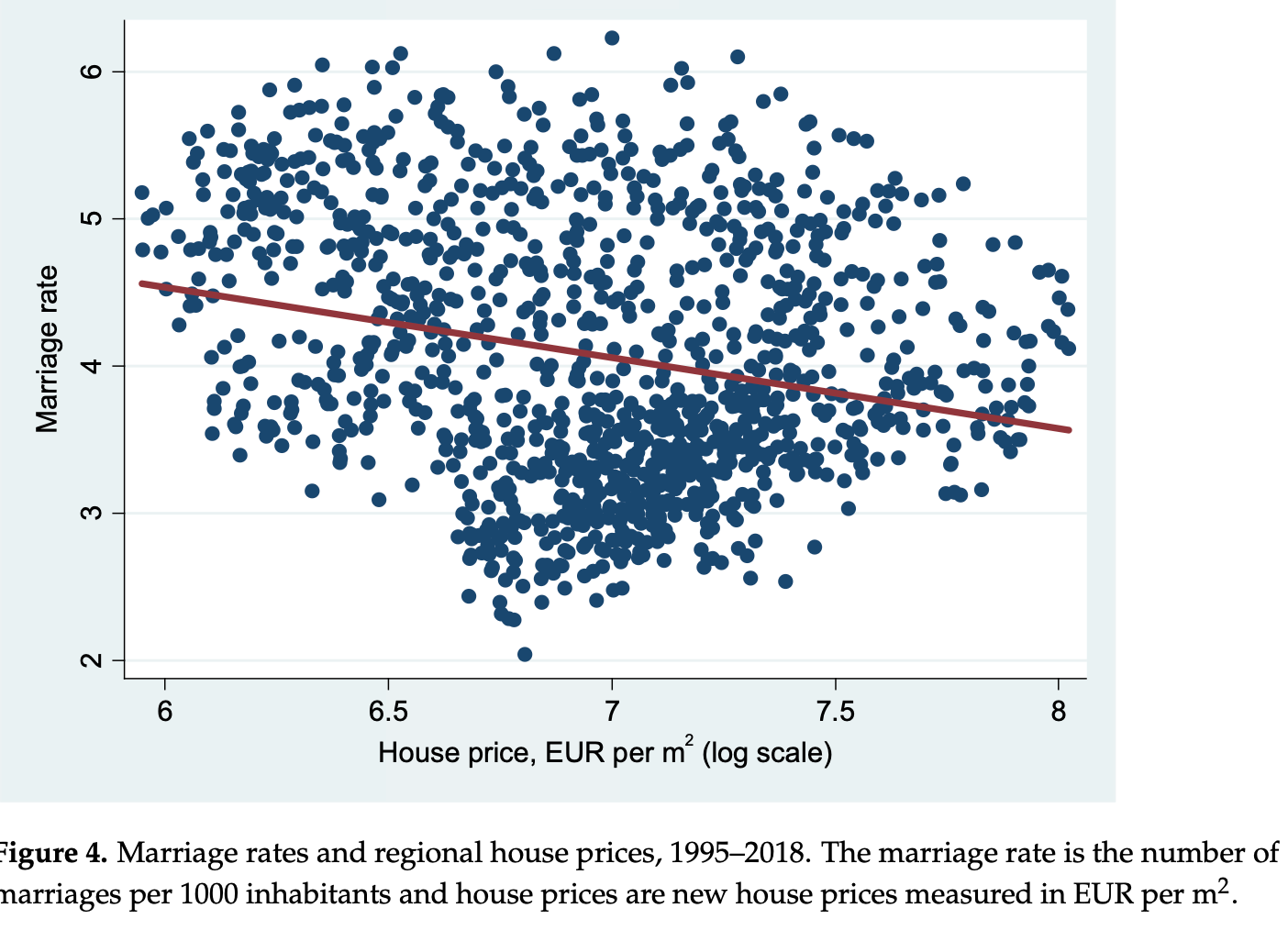
Source: Val (2022)
Considering a generation of young adults are increasingly priced out of both buying and renting (especially in major cities where the jobs are) they are forced to live with their parents much longer, pushing the average age of leaving home past 30. A little over half of all 25-29 year olds still live with their parents. Not only that, this housing trap pushes back the timeline for living with a partner/getting married and having children, which researchers point out is a major reason Spain currently suffers such low fertility (TFR ~1.12). It’s a clear domino effect: precarious jobs and expensive housing delay independent living, which in turn delays family creation and threatens the country’s long-term demographic stability.
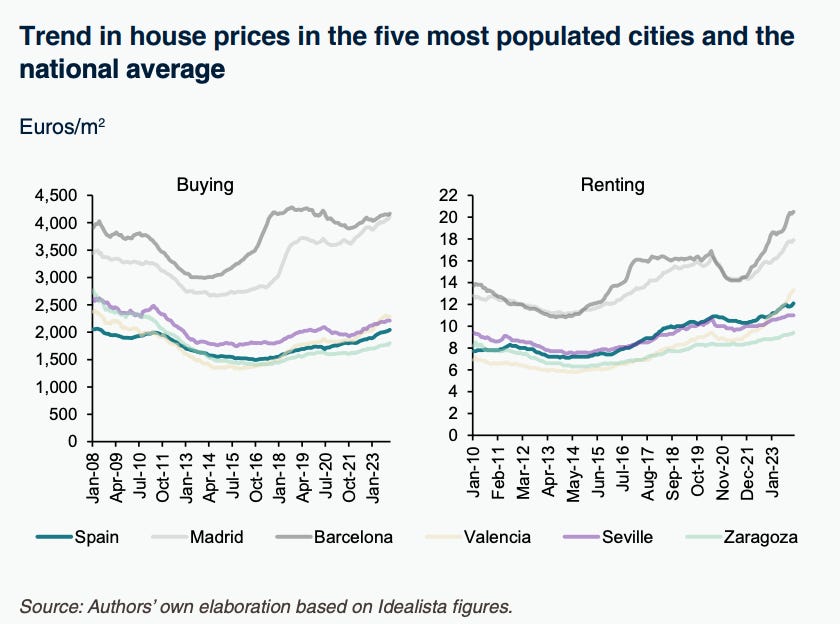
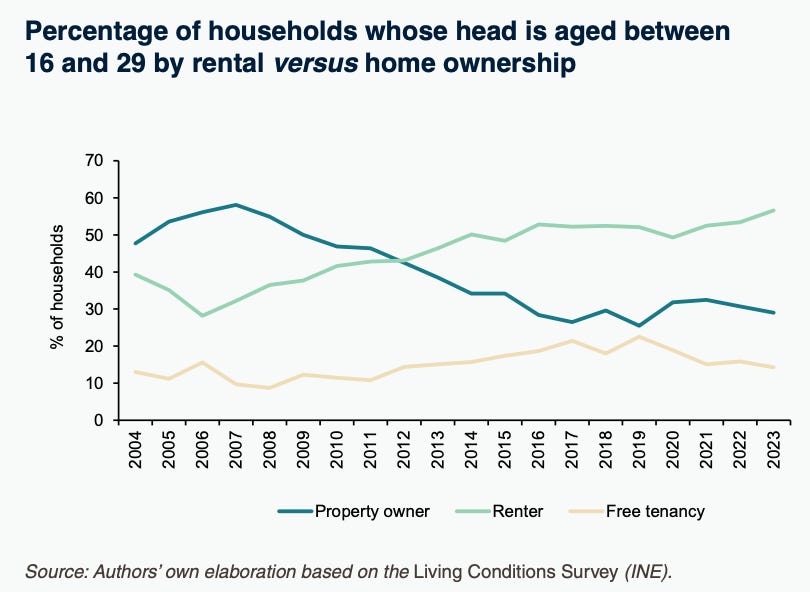
Source: Funcas SEFO (2024)
The vulnerability of Spanish youth is further exacerbated by the specific architecture of the Southern European welfare state. Compared to Nordic and even Central European peers, young Spaniards receive scant public institutional support to transition from education to employment or to achieve housing independence. The absence of robust public housing policies, youth housing subsidies, or comprehensive family formation grants leaves the family of origin as the sole provider of welfare. The ripple effects go beyond family formation of course:
A young employee would have to allocate 98.7% of their net salary to rent a home on their own in Spain. The estimated average age for leaving home is now over 30.
It also highlights that the difficulty of accessing housing is currently one of the main factors behind youth impoverishment in Spain: “Among young people who rent, the risk of poverty rises from 25.9% before paying for housing to 43% afterwards.”
“For young people, moving out means becoming poorer,” says Andrea Henry, president of the CJE. “The labour market and the housing market no longer speak the same language for young people,” Henry warns.
EuroNews (2026)
When you combine job insecurity with rising living costs, the result is a generation stuck living with their parents longer, unable to secure the steady income or savings needed to rent an apartment, let alone plan a wedding. Ultimately, long-term commitments like marriage aren’t just shifting because of cultural changes; they are being actively delayed by economic necessity.
What does this mean?
You guessed it. The most obvious demographic implication of this delayed age at marriage/partnership is a delayed start of childbearing. It’s important to note here that research shows women consistently report wanting to start their families much earlier: The ideal age for a first child sits at just 28.2 years for native Spaniards and 26.3 years for foreign-born women. This systemic postponement of childbearing and union formation isn’t driven by a lack of desire for children, but rather by structural obstacles.
According to the national statistical agency:
The average maternity age was 32.6 years in 2023. In recent years, the decline in the number of births has been accompanied by a delay in the maternity age.
By nationality, the average age of motherhood did not change, and remained at 33.1 years for Spanish mothers and 30.5 years for foreign mothers.
Another indicator that reflects the delay in motherhood is the number of births to mothers aged 40 or over, which has grown by 19.1% in the last 10 years. In relative terms, while in 2013 6.8% of births were to mothers aged 40 or older, in 2023 that percentage increased to 10.8%.
INE (2023)
Which brings me to the implication I would like to dive into today, the rise in Assisted Reproductive Technologies (ART), primarily In-Vitro Fertilization (IVF). As marriage and subsequent attempts at conception are pushed deep into the late thirties and early forties, natural fecundity drops precipitously. This has triggered a sharp increase in the demand for IVF, and has catapulted Spain into a European epicenter for reproductive medicine, accounting for 15% of all IVF treatments in Europe. 2 other statistics from that article stood out to me:
The increase in access to IVF is due to the delay in motherhood: mothers over the age of 35 now account for 40.1%.
Babies born by reproductive medicine techniques now account for 12% of all national births.
The societal reliance on ART to maintain even current sub-replacement fertility levels is remarkable (and not surprising per se, but still something when numbers are put to intuition.)
But a recent study points out, treating medical intervention as a guaranteed technological fix for structural delays is a flawed premise, and plays out differently depending on a woman’s education. The authors found that women without a university degree who experience late structural transitions (like finding stable employment) are actually less likely to use ART. Often, they adjust their fertility desires downward or are simply priced out of the treatments. Even among women who do access ART, the biological clock does not tick equally. While the likelihood of achieving a live birth drops markedly with age across the board, the decline is significantly less pronounced for university-educated women. They generally have the resources to undergo multiple cycles, access private clinics, or continue treatments for longer.
There’s a fascinating plot twist that’s playing out in real time. New research shows that indeed, while university-educated women hold the advantage in the IVF clinics, they face some penalties with respect to fertility intentions. Essentially, when researchers tracked the partnership and employment trajectories, they found that for women who marry, having a university degree lowers the likelihood of childlessness. But for women who experience relationship instability or remain single, higher education amplifies the childlessness rate. In fact, for university-educated women who remain single, the probability of permanent childlessness increases to over 80%, significantly higher than single women with lower educational attainment. This could all very well be a rational choice to remain childfree, and is an important hallmark of reproductive agency.
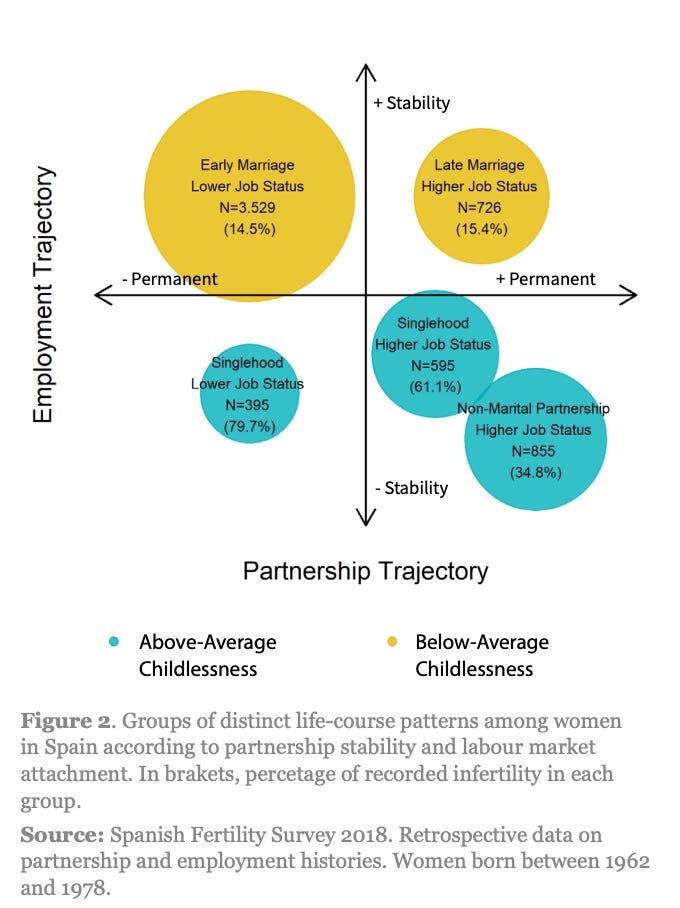
Source: CED (2025)
There’s likely two distinct pressures driving this. First, a simple marriage market mismatch: finding a suitable partner is statistically more difficult and takes longer for highly educated women. Second, there is an “investment” threshold. Highly educated women are much more likely to view formal marriage and a stable partnership as strict prerequisites for child-rearing. They prefer to have children within a framework that guarantees they can heavily invest in their child’s future—meaning they are actually less willing to pursue single motherhood, even if they have the financial means to access the ART to do so.
Looking Ahead
The most consequential implication of the delayed marriage and fertility collapse is the structural aging of the Spanish population and the threat it poses to the social and fiscal framework. According to projections by INE, the ratio of workers per retirees will plummet to a low of just 1.6 by 2050. This demographic inversion generates a massive, dual pressure on the state apparatus: a shrinking active tax base coupled with an explosive, non-discretionary increase in public spending on the elderly. I didn’t get into that today, but want to highlight that it is one of the most urgent, most pressing issue in the country with respect to demography.
If the average age at first marriage and first child is pushed to nearly 40, grandparents will be in their late 70s or 80s when the children are young. This demographic shift transforms the elderly from active care providers into care recipients precisely when their adult children are attempting to raise infants. This sandwich generation dynamic necessitates immense state intervention to provide both eldercare and childcare, severely straining public finances that are already heavily indebted.
There is this narrative that young people around the world are now too picky in choosing their partners (opting to keep swiping next on dating apps), too selfish to have children (god forbid they ruin their routines). But what Spain’s examples seem to be indicating (to me, at least), is that young people are trying to have families, just those of their own design. But they are being structurally blocked from achieving it by an impossible housing market and precarious youth employment. Instead of abandoning family life, they are fighting to build it on their own terms, whether by redefining unions through parejas de hecho or leaning on IVF. Desired fertility is still much higher than actual fertility. Young adults aren’t walking away from parenthood; they are fighting against an economic system that has priced them out of it.
The Food!
I mentioned the tapas! What’s better than one demographer (and her economist husband) making tapas? THREE demographers (and their economist + adjacent husbands!) We made a whole bunch of fishy and meaty delights, drank a lot of wine, and had a lovely time. We listened to Rosalia who we are obsessed with - she has arguably one of the best albums of this year. Of course, we transitioned to Bad Bunny eventually.

Your blog gets better and better. Can’t wait to sample your cooking too!