I danced around the idea during the U-5 mortality, maternal mortality, and fertility pieces on how central the age at marriage is in each of those indicators, particularly for women. Because childbearing in many countries happens almost exclusively within marriage, early marriage almost always means early motherhood. But what else does the timing of marriage portend for future trajectories?
Nepal’s Gen Z is making international headlines for toppling the government and electing a disruptor (rapper!) like Balen Shah as Prime Minister (at only 36 years old!) But the demographic data tells a more complicated story about who exactly has the agency to participate in this movement. While urban centers see higher education and heightened political engagement from young people, over half of the young women in marginalized communities are still married as children. It turns out that Nepal isn’t just navigating a political transition; it is managing a fractured demographic reality. Today we dig into exactly that by investigating the median age at first marriage.
But first: what’s happening with marriage globally?
During my doctoral training, there was this understanding that marriage continues to be a universal milestone, even if definitions on what marriage is may be changing. Meaning, more people were opting to forego marriage, choosing to live together/cohabitate without the legal tag, but continuing to have children and create family units nonetheless.
Turns out, marriage (or “in-union” which includes cohabitation) is on the decline around the world. Data from the UN (compiled from censuses, surveys, civil registration etc) shows the trajectory for women 15-49 around the world with projections to 2050:
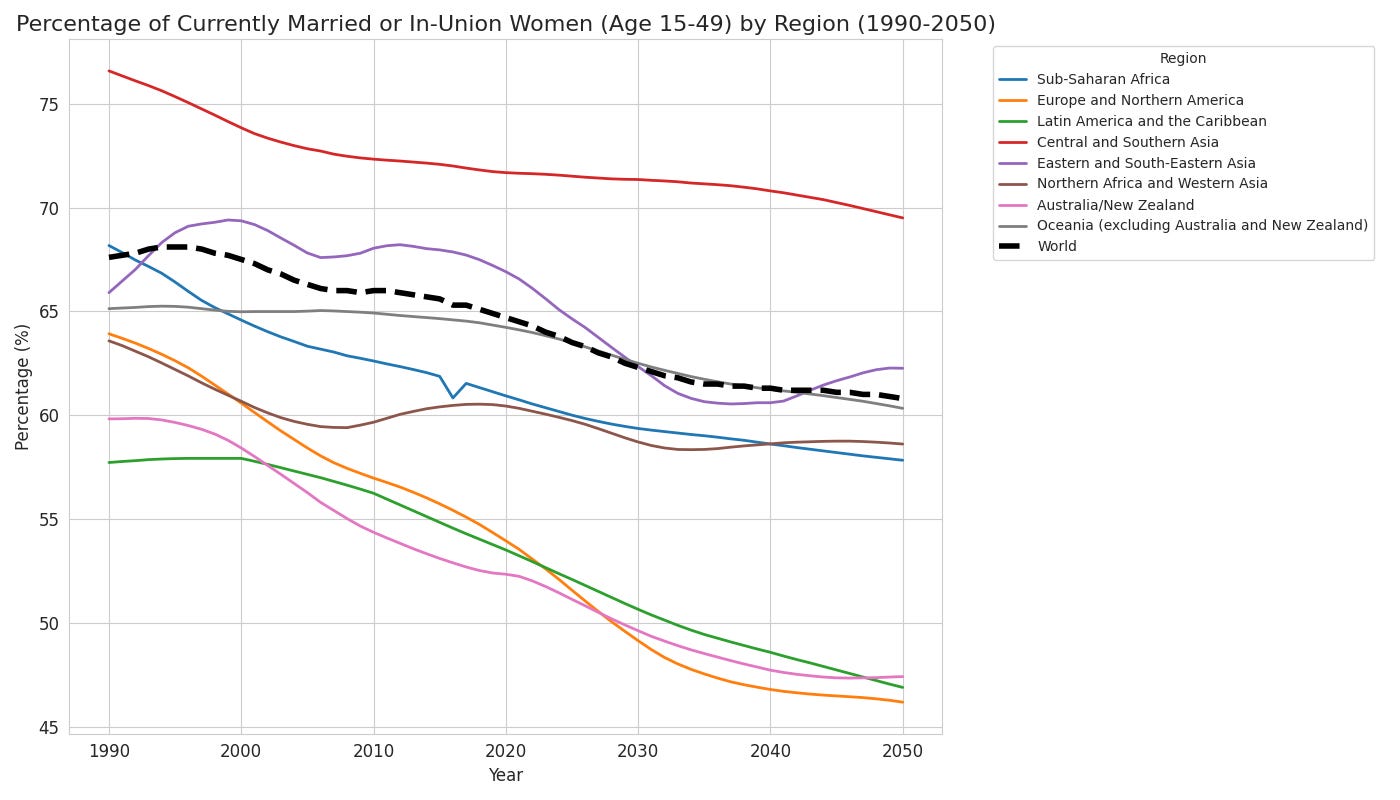
Central and Southern Asia (red) maintains the highest marriage and union percentages throughout the entire timeline with about 70-75% of women married (although showing a declining trend too). Europe and Northern America (orange) experienced low percentages (between 45 and 50%) and the steepest declines in the time period.
The reasons for the decline are many; we covered some of them in our South Korea and Singapore pieces. Essentially, in previous generations, marriage was seen as this cornerstone to achieving other things; the starting point of becoming an adult where couples build not only their families, but also wealth together. Today, marriage is increasingly seen as a nice to have, not a need to have. Millennials and Gen Z often feel like they have to attain all the things first before they get married. That could be anything from buying a home, establishing careers, finishing education and more. But, because achieving financial stability takes so much longer today, marriage naturally gets pushed into late 20s, 30s, or not at all.
On a macro level, the relationship between a country’s GDP and the gap between male and female age at marriage looks like this:
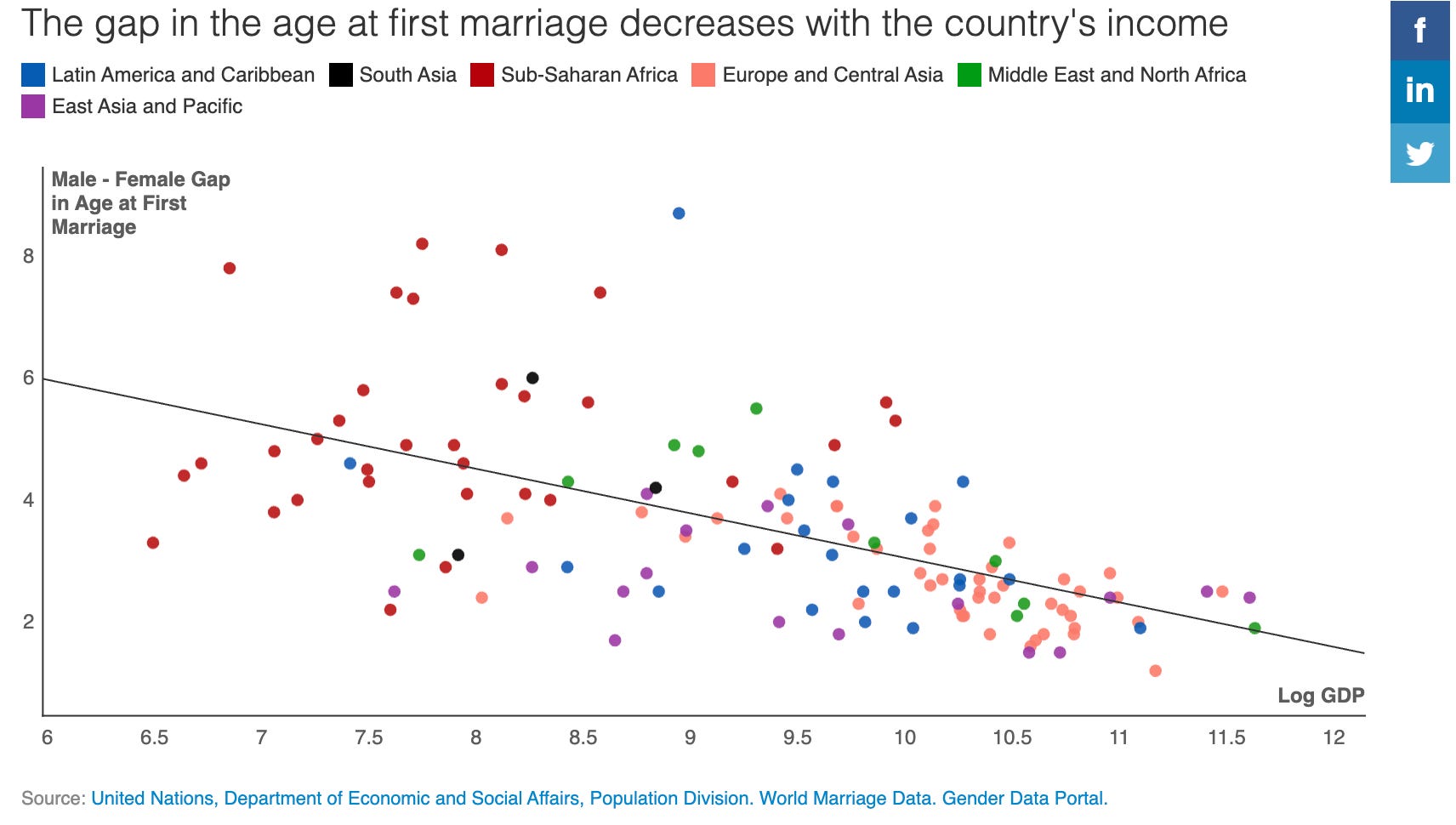
Source: World Bank (2020)
Essentially, as a country gets richer, both men and women marry later. However, women’s age at first marriage increases faster with income than that of men’s. Therefore, the gap in the age of first marriage is decreasing with the country’s income. The reasoning could be that richer countries tend to have higher educational attainment and people with more schooling are more likely to interact and marry similar-aged peers.
Marriage in Nepal
That said, in Nepal, marriage is still nearly universal. It has some of the highest marriage % in the world (fourth only to Bangladesh, Niger, and Mali) at about 75% of women and 63% of men reporting as such. [A negligible proportion are “in-union” (about 0.2%), so henceforth I will refer to the combined category as “married.”] By mid-century, about 68% of women are projected to be married, which is a decline from where we are now, but not by much.
Given the high % of marriage, and knowing that arranged marriages were still quite prevalent particularly in some communities (although declining proportionally); I thought surely there would be a huge gap in spousal age. It turns out not to be the case in Nepal after all:
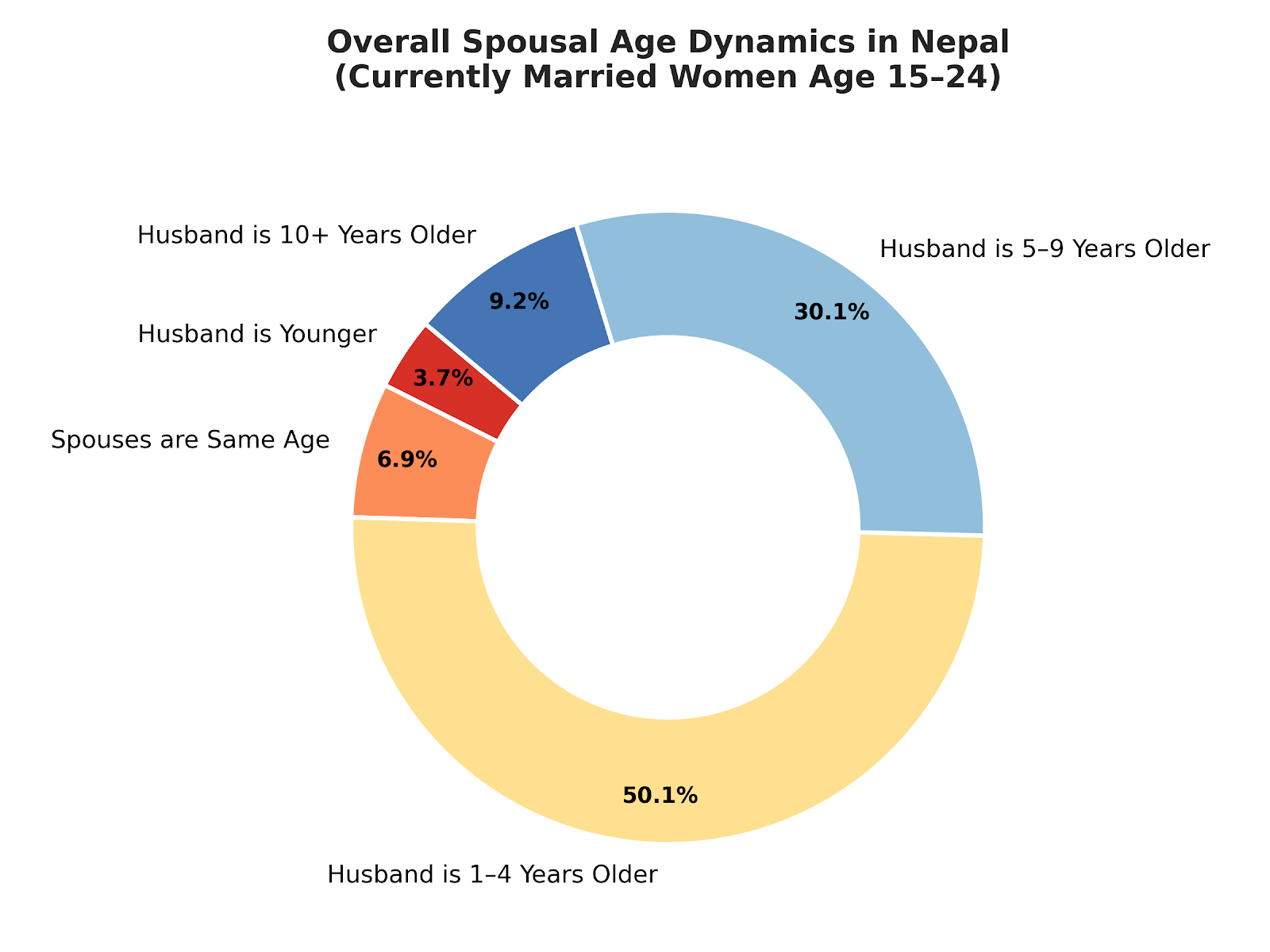
About half of women marry men 1-4 years older than them followed by about 30% that marry men 5-9 years older than them. The egregious 10+ years older category is relatively small, at 9%. I would wager that women who marry very young likely have larger spousal age gaps. Unfortunately, I don’t have the microdata downloaded to play along, but perhaps someone can tell me. I am basically using Statcompiler for all my data/graphs.
BTW, if you were wondering, same-sex marriage is provisionally recognized in Nepal (the first in South Asia)! According to Pew’s tracker, an interim Supreme Court order led to Nepal’s first federally registered same-sex marriage in 2023. In 2024, the federal government directed all local governments to register same-sex marriages. While gay and lesbian couples can marry, there is not yet a marriage equality law on the books.
Marriage registration - unsexy but undeniably important.
Speaking of registration, come with me on a tangent about the importance of civil registration and vital statistics (CRVS) systems. [I’m a lot of fun at parties.]
I was pleasantly surprised to find that marriage registration rates are pretty high in the country. 81% of women age 15–49 have their marriage registered with the civil authorities. Although, rates are lower for younger women.
This is impressive (and thrilling) because marriage registration - while seemingly unsexy - is so powerful. Civil registration is the recording of important events in an individual’s life. It includes birth, death, marriage, and divorce. Everyone benefits from an effective civil registration system. It helps people prove identity and legal status with certification and national identification, empowering individuals to exercise their rights and access public services.
For women especially, it’s foundational. It is the state’s legal recognition of a woman’s existence independent of her husband, which is crucial for her financial survival and agency if he migrates or passes away.
The absence of death, marriage, and divorce certification pose challenges to inheritance and the smooth transfer of property. This has a particularly strong gender dimension as ambiguity over vital events impugns the legitimacy of many spousal claims to property and child custody, disproportionally undermining female property, inheritance, and parental rights
World Bank (2022)
In Nepal, women can only get a widowhood pension if they have proof of their marriage, along with death and citizenship certificates for their late husband. I saw this during fieldwork in South India as well: women who did not have marriage certificates were unable to receive death certificates upon their husband’s death, and could not even access the meagre widowhood pension they were due. Adding to that disputes over any property or assets without paperwork means spiraling them further into financial hardship when they were at their lowest. Nepal: winning in this aspect.
Median age at marriage
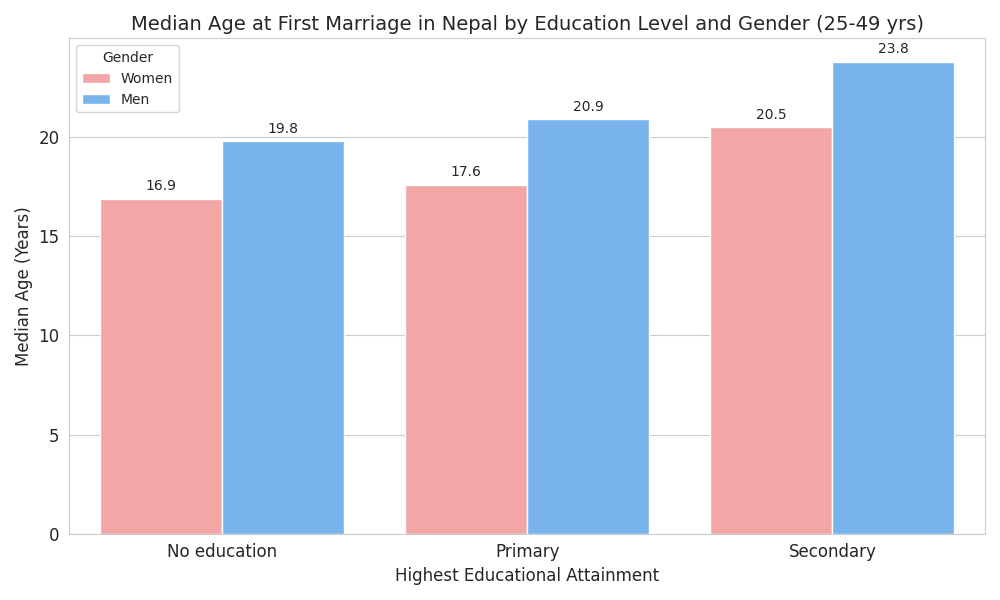
The legal age for marriage in Nepal is 20 for men and women. But the data shows that marriage takes place far earlier than that. Nepal’s 2022 DHS data shows that 12% of women (age 25–49) were first married by age 15. The median age at marriage is 18 for women and 22 for men. What that means is that half of women were married almost 2 years lower than the legal age of marriage.
The differences by education are stark: For women and men with no education, the median age at first marriage is 16.9 (!) and 19.8 respectively, and jumps roughly 4 years for those with secondary education or higher.
OK but what’s underneath those numbers?
Median age at marriage tells us the tip of the iceberg of the story. The drivers are where the real substance lies. There’s two here I want to point out, although there are a number of other factors that you can guess (poverty, lack of education, insecurity/climate shocks, etc.). In short:
Religion
According to the latest Census (2021), Nepal is largely a Hindu country (81%), with sizable populations adhering to Buddhism (8%) and Islam (5%). 42% of Hindu women and 49% of Muslim women were married before the age of 20. This is meaningful. Research finds that marriage customs, particularly dowry, persist widely and are socially endorsed, fostering economic reliance and sustaining gender inequality. Indeed, marriage in Muslim and Hindu communities is institutionalized through dowry, early marriage, and gendered household labor, shaping women’s identities as wives and mothers. Younger brides often require lower dowries, creating an economic incentive for early marriage. In Nepal, there is evidence that underage Muslim wedding ceremonies are sometimes unregistered and conducted following religious customs. This means that this important document does not exist for young women being married off early, with weak subsequent inheritance and bargaining power in their households. Not to go off too much on another tangent here, but one way of gaining status in households across South Asia has been to have a male child. The data reveal a complicated relationship between dowry and son preference - I will explore this in greater detail later in the series with yet another demographic indicator- sex ratio at birth.
Agrarian pressures and migration
One of the most well-known demographic phenomena in Nepal is the massive out-migration of men. According to the 2021 Census Data, a total of 2.2 million Nepalis are abroad, out of which 81% are male, and half are young (age 20-29). Consequently, ⅓ of working age men in Nepal are abroad, with remittances driving 30% of the country’s GDP. We will cover remittances in greater detail in another post. Are you tiring of all these teasers?
One of the regions with the lowest median age for marriage for men is Karnali (20.3). It is Nepal’s most rugged, mountainous, and impoverished province. In subsistence agrarian economies, early marriage for both women and men is often encouraged to secure household and agricultural labor. Karnali is also the region that experiences high rates of male out-migration (often to India or the Gulf). This out-migration is tied to age at marriage: Men frequently may marry young to establish a household and leave a wife behind to care for their parents and land before migrating for wage labor.
Related, male out-migration also plays a fascinating role in fertility decline: A central paradox in Nepal was that the TFR was dropping significantly, yet there was no massive, corresponding surge in national contraceptive use. Research like this finds that male migration was the missing link, demonstrating that spousal separation (acting essentially as "natural contraception") played a crucial role in reducing the country's fertility rates.
What are the implications of younger age at marriage?
When women marry younger, they tend to have a big age gap with their husbands, which in turn, is associated with lower decision-making ability. Young brides may not be able to negotiate safe sex with their husbands, resulting in early childbearing and higher fertility. In Africa and Latin America, it is also associated with higher HIV infection rates. There’s 3 buckets from Nepal that I think are interesting here with respect to power dynamics and household decision making (again, data from the DHS):
The Healthcare Deficit (72%) At a national level, 72% of married women in Nepal have a say in their own medical care. But when a girl marries in her early teens, she almost entirely falls out of this empowered majority. Entering a household at a young age places her at a power disadvantage, meaning she is rarely the one with the social authority to seek medical help. If a young mother cannot independently decide when to visit a clinic, the physical strain of early childbearing is compounded by a dangerous lack of access, directly fueling maternal and under-5 mortality spikes.
Financial Marginalization (60%) Nationally, only 60% of women are involved in major household purchases, the lowest of the three empowerment indicators. Early marriage almost guarantees a woman lands in the marginalized 40%. By cutting her educational trajectory short, early marriage strips a young bride of the human capital needed to generate her own income or assert bargaining power. She is absorbed into a household where economic decisions are dictated by an older husband or in-laws, leaving her with zero financial agency to invest in herself or her children’s immediate needs.
Restricted Social Mobility (68%) While 68% of women have a say in visiting family or relatives, adolescent brides face intense restrictions on their freedom of movement. The inability to move freely or seek counsel outside the husband’s home isolates young brides from vital social safety nets. It prevents them from seeking refuge, accessing community resources, or gaining the external support needed to negotiate family planning and contraceptive use within the marriage.
A young woman who cannot make her own healthcare decisions, who is financially marginalized, and whose social mobility is restricted is functionally locked out of the political awakening sweeping the country. She isn’t just missing out on adolescence, but is in essence missing out on citizenship.
Age at first birth
The timing of marriage is directly linked to another demographic indicator (I am cheating this week, you get 2 indicators at the price of one long post.)
If you are married off early and live in a society where having children happens within marriage rather than outside of it, then the act of marriage starts your potential childbearing clock. Theoretically, if you are married at 16 versus 25, you have more years to potentially have children, and logic may conclude that you would have more children over the course of your life.
On the macro level, this appears largely true:
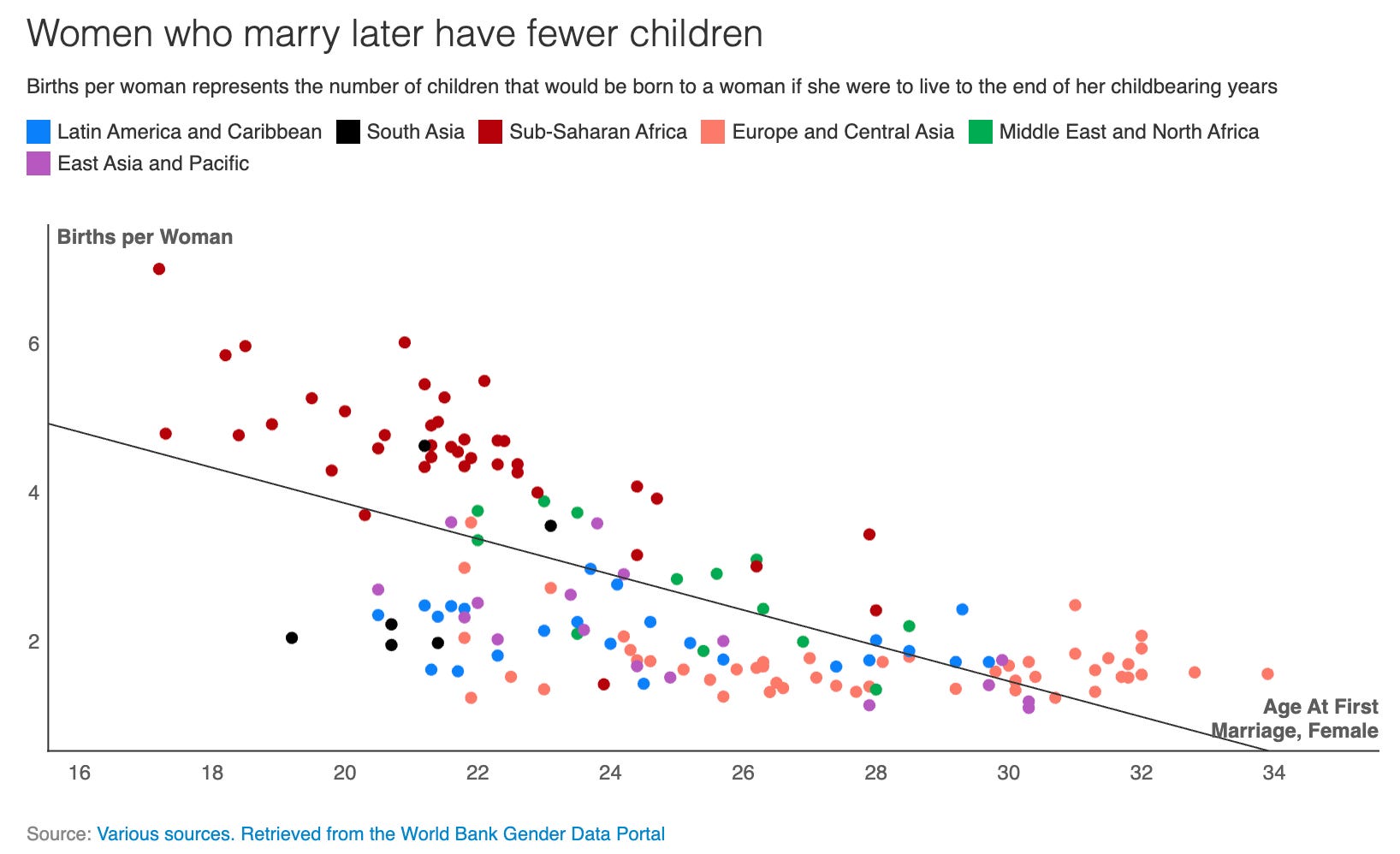
In countries where women marry later, they have fewer births in their lifetime. Women who marry at age of 21, on average, have 3.1 births, while women who marry at the age of 25 have 2.4 births. The declining pattern seems to taper off after around two births, which is the population replacement rate.
When women marry young, their longer window for childbearing naturally drives up overall fertility rates, but the physical strain on still-developing bodies and lack of healthcare access cause maternal and under-5 mortality to spike. Conversely, delaying marriage into the mid-30s may push overall fertility down and creates a stark survival trade-off: older mothers have the social and financial stability to help their children thrive past infancy, but the biological realities of aging bring a sharp, renewed risk of severe maternal and newborn complications (cardiovascular risk etc.)
In Nepal, it does not seem to actually shift when the first birth takes place, nor result in more children being born altogether. Across all provinces, Nepal is at or below replacement level for fertility.
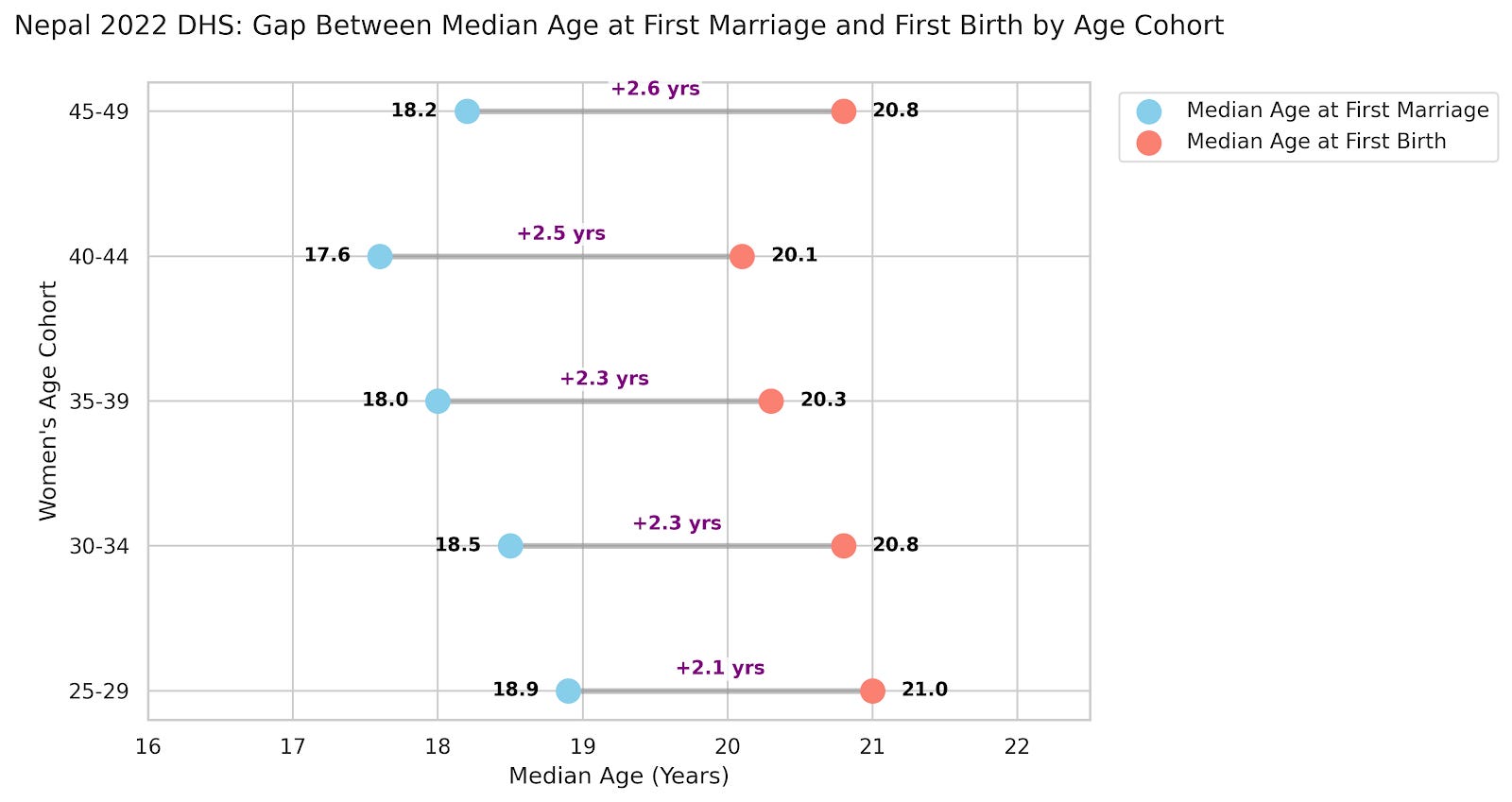
The figure above is instructive because it separates women by birth cohort. It compares the same indicators, but for women in different age groups. It helps see what trends look like in a given country in a more nuanced way. What this tells us is that the median age at first marriage has steadily increased for younger cohorts. Women currently aged 40–44 had a median marriage age of 17.6 years, whereas the youngest cohort right now (25–29) married at a median of 18.9 years. Interestingly, despite the rising age of marriage in younger cohorts, the gap between marriage and first childbirth remains relatively stable, hovering between 2.1 and 2.6 years across all groups. The youngest cohort (25–29) exhibits the highest median age at first birth (21.0 years) compared to older cohorts, reflecting perhaps broader national trend inching toward delayed family formation.
Looking ahead
The international headlines coming out of Nepal will likely continue to focus on the political shakeups, the sweeping reforms, and the rising power of a frustrated, hyper-connected Gen Z. But demography constantly reminds us that a country’s future isn’t solely written at the ballot box; it is shaped in the domestic spheres of its most marginalized communities.
Right now, participating in Nepal’s political and economic awakening is a privilege largely reserved for the cohort that enjoys delayed family formation. True national transformation cannot be achieved while over half of the young women in marginalized pockets are still married as children.
Shifting the needle on the median age at marriage isn’t just a public health imperative. It is a democratic one. It is about extending education, securing inheritance rights, and giving young women the sheer physical and social mobility required to participate in civic life.
Nepal’s youth may have disrupted the government, but until the country bridges this fractured demographic reality, the revolution will remain incomplete. A new political era has arrived, but millions of young women are still waiting for the autonomy to actually live in it.
The Food!
Much like you, I also get a lot of my recipes and plans from Instagram. One that popped up and I couldn’t get rid of a few months ago was this seemingly rancid chaat with oranges and yogurt that I knew I had to make. So, this week we made maas ko daal (black dal), bhat (rice), cauliflower tarkari, loads of pickles (I found a Nepalese sichuan pickle- amazing!), and drumroll please the chaat. It was SO good! so refreshing, surprising, and we will definitely make it again.