

The United States has long been heralded as “a nation of immigrants.” While that’s complicated), it is the top destination for international migrants, and so we delve deep into migration for this week and next week’s pairing. Of the 51.9 million immigrants in the country, about 22% are born in Mexico, followed by India and China (both at 6%), Philippines (4%) and Cuba (3%). For a more complete picture, see this map:
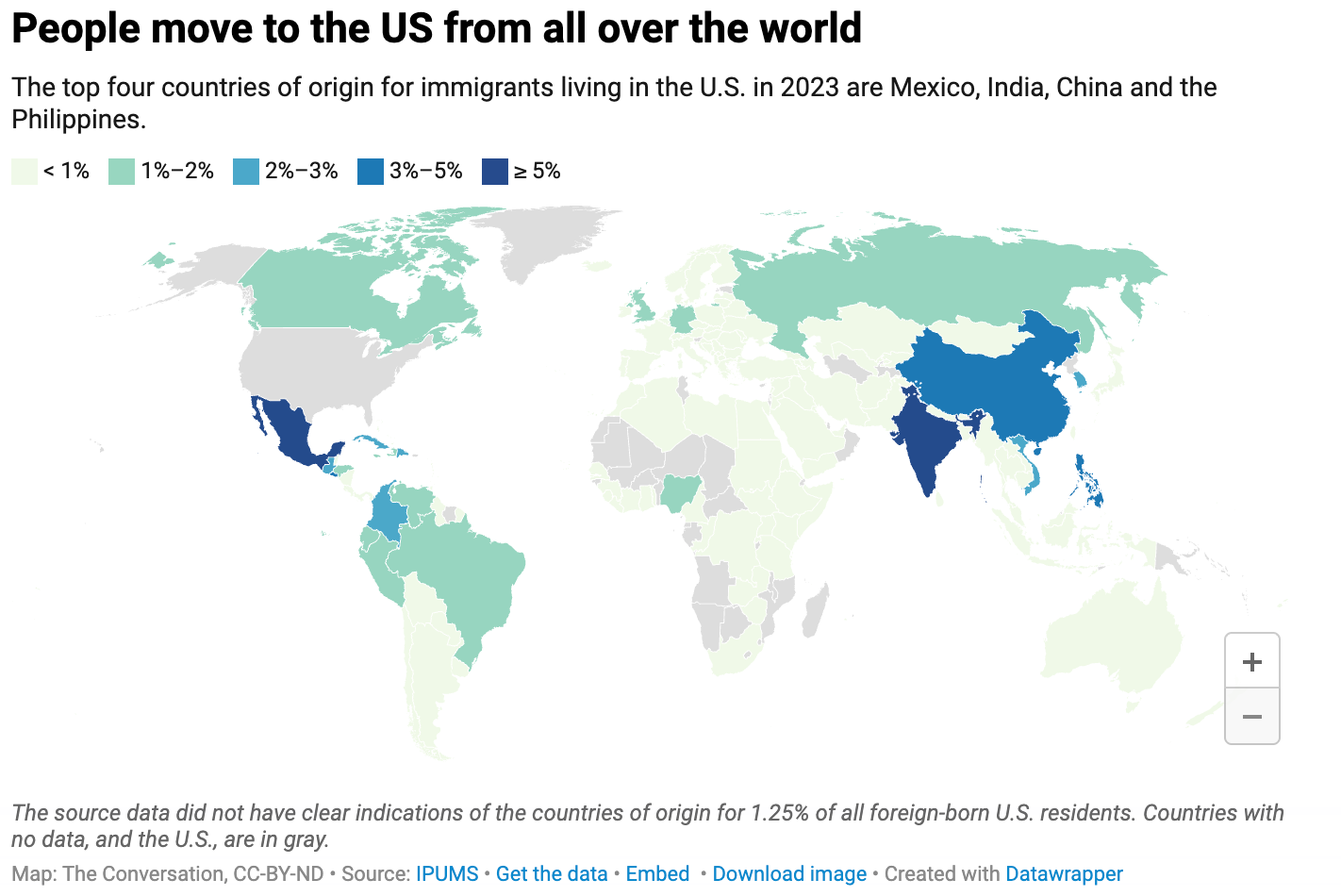
Source: PBS (2025)
Immigration been a particularly loud issue of late: Headlines highlight an intense, administration-led immigration crackdown in the U.S., featuring record deportations, legal battles over detention policies, and more. The implications are massive, and are still being parsed out in real-time as the crackdown continues.
A 2025 KFF/New York Times survey reveals that during the first year of President Trump’s second term, immigrants across all legal statuses have experienced a significant rise in fear and anxiety linked to intensified enforcement, with 41% now worrying they or a family member could be detained or deported. This climate of fear has led many to avoid public spaces and medical care, while simultaneously exacerbating economic instability as more families report struggles to afford basic necessities like housing and food. These pressures have tangible health consequences, including increased stress and worsened chronic conditions, and have notably reshaped political perspectives, with more immigrant voters expressing a shift away from the Republican party due to its immigration policies. While most immigrants still value their decision to move to the U.S., a strong majority now believes the country has become less welcoming than it once was.
If you read these headlines, you would assume – well – what you want to assume based on your preconceived notions about the importance of migration and the value-add of migrants I suppose. The topic of immigration is a political hot-button issue in this country, and I will not assume, Dear Reader, that you share my views. Indeed, a Gallup poll from July 2025 showed that 55 percent of Americans want to see lower levels of immigration—the highest such result since 2001 and up from 41 percent just a year earlier (see Figure for trend lines).
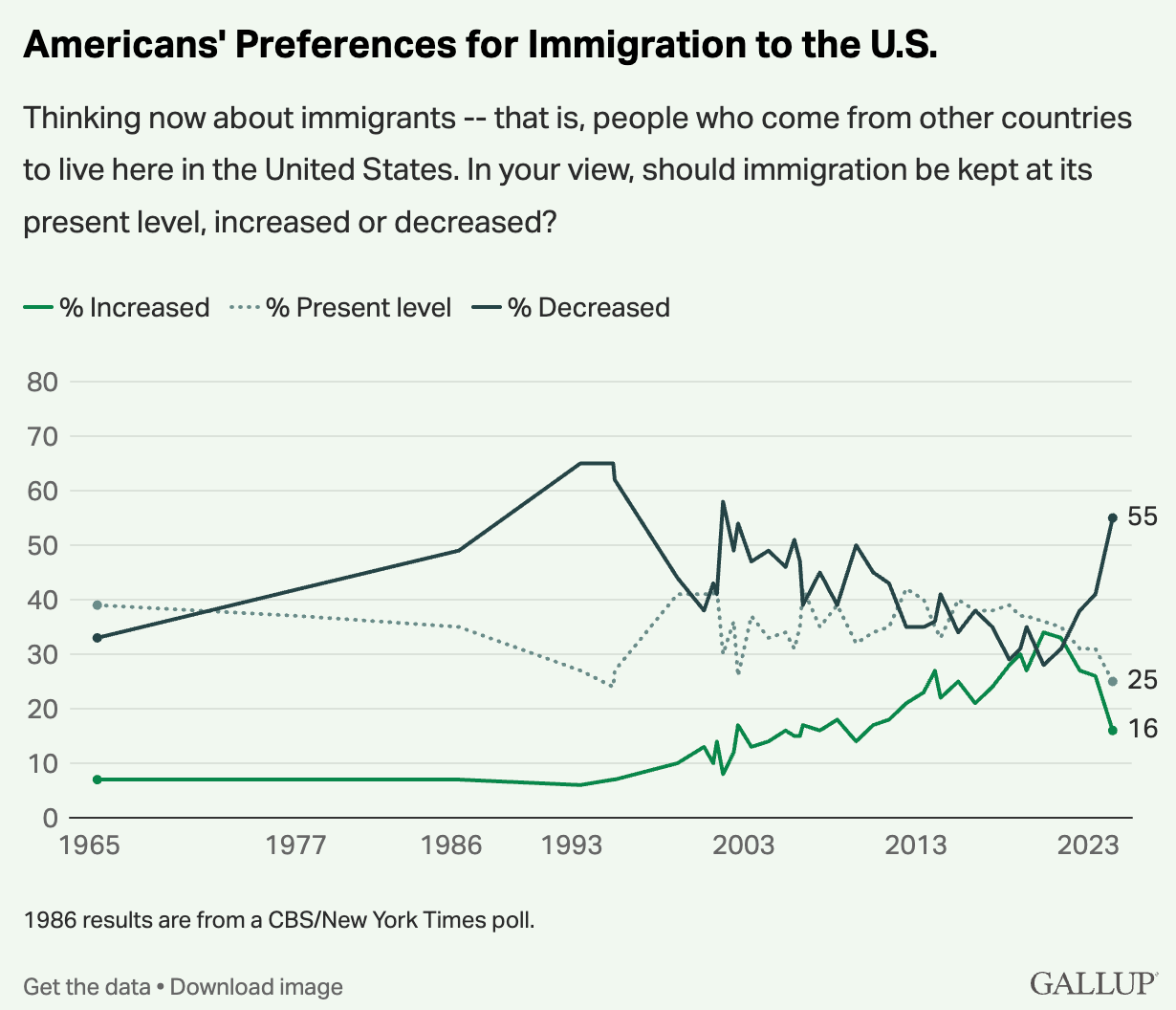
Source: Gallup (2024)
Immigration as an engine of population growth
As the Population Reference Bureau notes,
Population growth comes down to two things: more babies being born than people dying (what demographers call “natural increase”) and more people moving in than moving out (called “net migration”). In recent years, immigration has driven much of the U.S’s population growth, helping sustain U.S. demographic exceptionalism even as growth slowed or reversed in many other affluent nations.
For decades, the American demographic story was written in a single, predictable script: a low-fertility native population supplemented by a steady, robust engine of international migration. That script has not just been revised; it is being fundamentally rewritten. Between 2024 and 2026, the United States has shifted from an era of expansion to an era of tightening, as net international migration—once the reliable propellant of our labor force and consumer markets— experienced a historic decline, dropping from 2.7 million in 2024 toward projected lows of roughly 321,000 by mid-2026. This isn’t merely a pause in the numbers; it is a profound pivot. As the aging of the U.S. population accelerates and the dependency ratio tightens, the reliance on net migration as a shock absorber for our economy is no longer a given—it is becoming the nation’s most acute demographic challenge. If current trends persist, the U.S. could face population decline within the next decade—an unprecedented shift for the nation.
This week, I present a data-backed exploration of immigration to the U.S., and implications using the framing of common myths and misconceptions.
Myth #1: The U.S. has historically been a country of migrants, but they have now overtaken the “native born” population.
Would I be a demographer if I didn’t start with a definition? There’s a few ways to think about the definitions of migrants.
The first generation (immigrants) is the group that is arguably the most talked about, These are people who are not U.S. citizens at birth. They include naturalized U.S. citizens, lawful permanent residents (also called green-card holders), refugees and asylees, certain legal nonimmigrants (including those on student, work, or other temporary visas), and persons residing in the country without authorization.
The second generation are U.S.-born individuals with one or more immigrant parents.
Third generation or higher are U.S.-born individuals with both U.S.-born parents. I would argue that this group is no longer technically considered “migrant”, although they may continue to socially be treated as the “other”. After hemming and hawing about definition, I admit I use “immigrants” and “migrants” interchangably in this piece, but am really talking about that first-gen bucket.
According to the Pew Research Center, as of June 2025, 51.9 million immigrants lived in the U.S., making up 15.4% of the nation’s population. This was down from just January 2025, when there were a record 53.3 million immigrants in the U.S., accounting for 15.8% of the country’s population – the highest percentage on record. This sharp decrease is due to a variety of factors, most notably that more immigrants left the country or were deported than arrived. By June, the country’s foreign-born population had shrunk by more than a million people, marking its first decline since the 1960s.
The median age of the immigrant population in 2023 was 47, making it older than the U.S.-born population, which had a median age of 37 years. This fact surprised me - I imagined the number would be much, much lower. One reason for this difference is that immigrants arrive largely as adults, whereas their U.S.-born children contribute to the younger median age of the native-born population.
Even as the nation’s immigrant population has declined in recent months – a change that may be partly artificial due to a declining survey response rate among immigrants – the U.S. is home to more immigrants than any other country. That said, 15.4% hardly constitutes a “takeover” of the native-born population, but undoubtedly a thrumming, integral part of the U.S. economy and social fabric. In a few weeks, we will talk about another immigration pairing, where in some countries, immigration accounted for nearly all the population growth there.
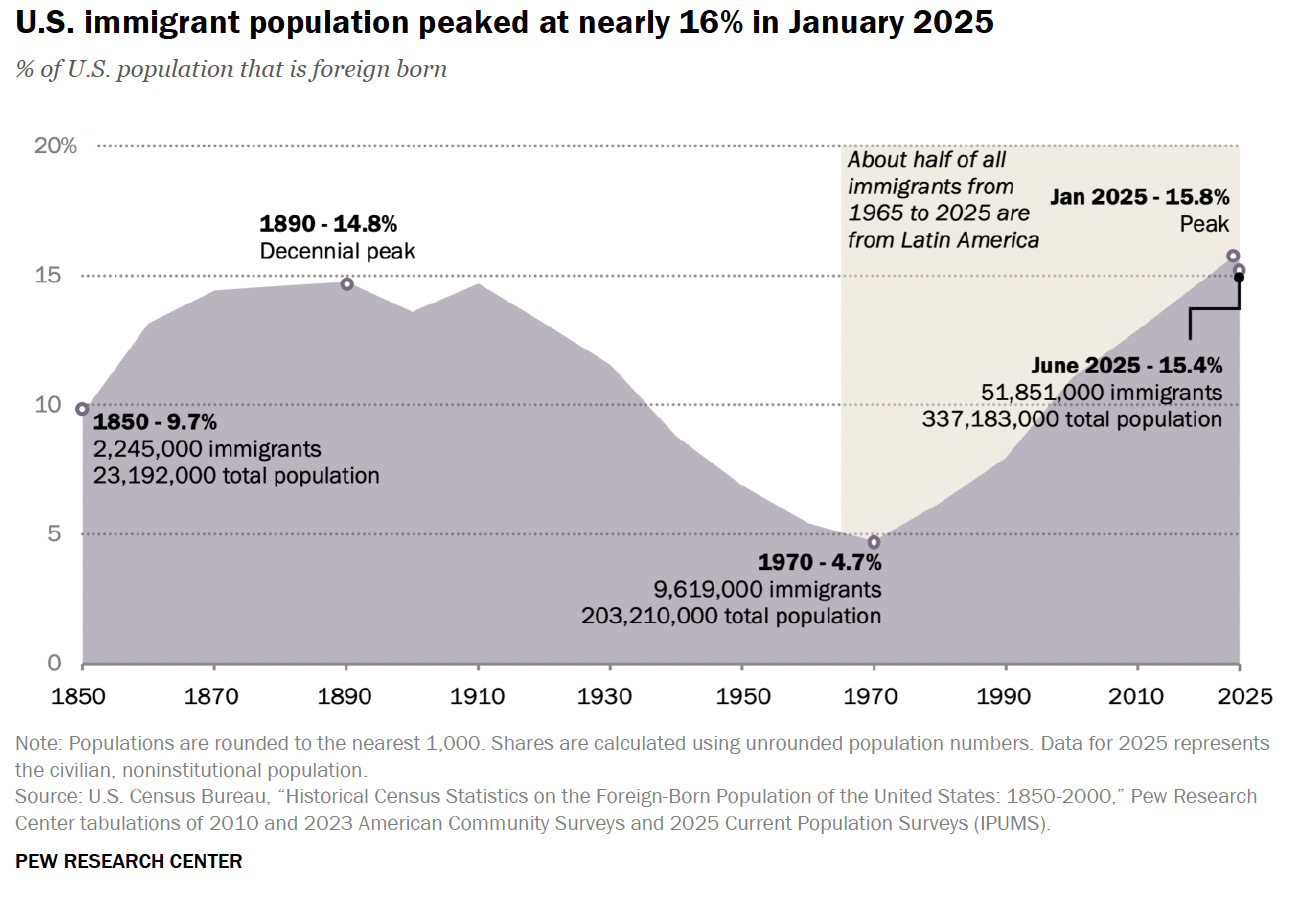
If you are curious about what happened in 1965, it’s a direct result of the Immigration and Nationality Act which abolished the national-origins quota system in place since the 1920s, which had favored Northern Europeans. It established a new system prioritizing family reunification and skilled labor, leading to a massive increase in immigration from Asia, Africa, and Latin America.
The fear then is that could - left unchecked - the proportion of migrants in the U.S. increase from 15.4% to even higher? I think where the actual fear of the “takeover” is, is not in immigrants in numbers relative to native-born populations, it’s the birth rate by ethnicity. A recent JAMA article showed that while the birth rate is declining for non-Hispanic Whites, it is not singularly declining just for them relative to other groups - it is also declining for Asians and Black populations, but increasing for Hispanics (more in the next myth below.)
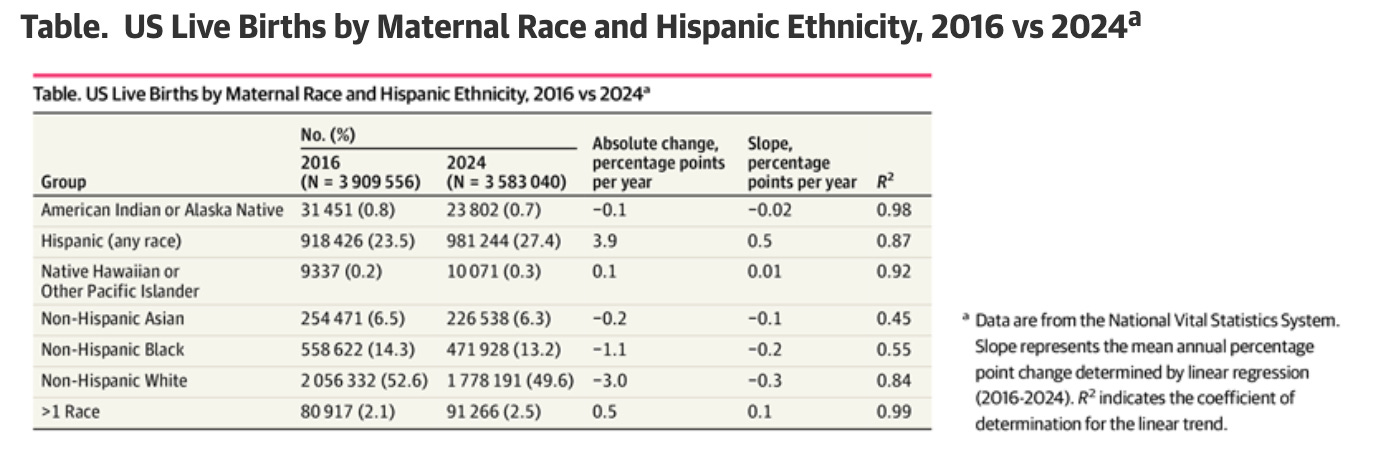
Source: JAMA (2026)
Myth #2: The white population is shrinking, and it’s all thanks to immigration
This one is partly true, and I think is the subtext behind the sentiment that immigration is bad and a lot of the fear-mongering. According to the U.S. Census Bureau, one in three Americans—32 percent of the population—is projected to be a race other than White by 2060.
But, it’s not driven by highly fertile immigrants from south of the border (a common misconception): The fastest-growing racial or ethnic group in the United States is people who are Two or More Races, who are projected to grow some 200 percent by 2060. My Indian-Turkish children are part of that lovely mix, and their ability to just be normal American kids is what makes this country beautiful. I digress; the next fastest is the Asian population, which is projected to double, followed by Hispanics.
In contrast, the only group projected to shrink is the non-Hispanic White population. Between 2016 and 2060, the non-Hispanic White population is expected to contract by about 19 million people, from 198 million to 179 million, even as the total U.S. population grows. This decline is driven by falling birth rates (due to many, many reasons) and a rising number of deaths over time as the non-Hispanic White population ages. Nonetheless, non-Hispanic Whites are projected to remain the single largest race group throughout the next 40 years.
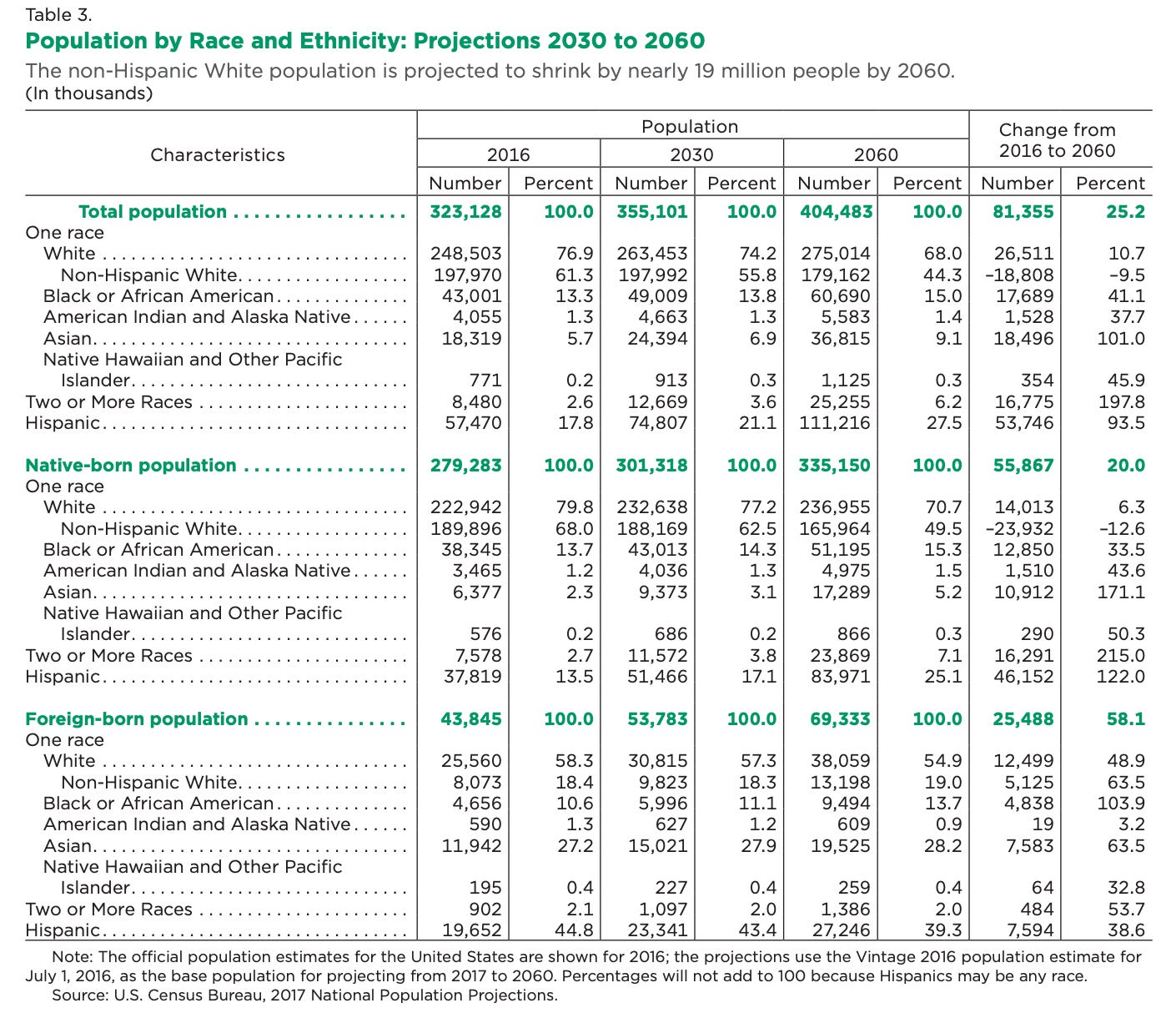
Source: U.S. Census Bureau
Myth #3: Most migrants in the U.S. are unauthorized and illegal
First, language matters, and language is ideological. Research shows that liberals favor terms like “undocumented” and “unauthorized,” while conservatives more commonly deploy terms like “illegal” and “aliens.”
I know I keep returning to Pew data, but honestly, they are doing such amazing work on the topic (thank you!) Unauthorized immigrants were 27% of the U.S. foreign-born population in 2023, which means an overwhelming majority are lawful, legal residents.
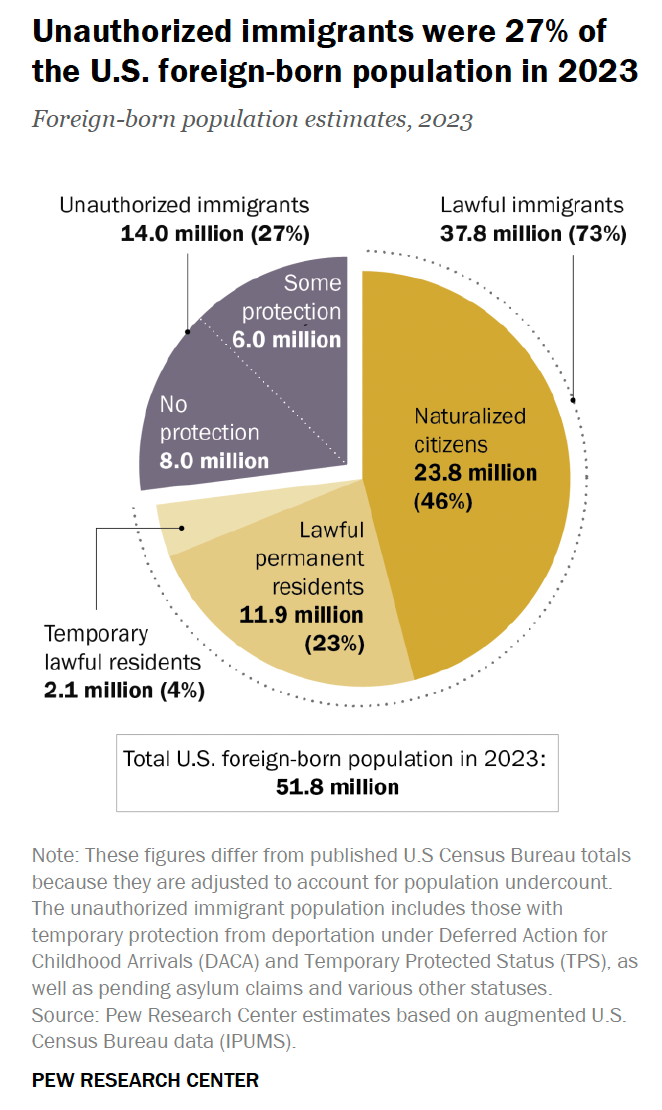
Source: The Pew Research Center (2025)
That 27% is more interesting still, because within this group, about 6 million (or a little more than 40%) had some form of temporary protection from deportation, with some also having a permit to work in the U.S. These include:
2.6 million asylum applicants;
700,000 people who entered the U.S. legally after receiving parole;
700,000 victims of crime and violence; 650,000 people with Temporary Protected Status (TPS), a program available to immigrants from countries facing war, natural disasters and other crises;
600,000 immigrants who were brought to the U.S. illegally as children and are enrolled in the Deferred Action for Childhood Arrivals (DACA) program.
Another 1 million migrants encountered U.S. Border Patrol before being released into the U.S., typically with an order to appear in immigration court. These immigrants have had more limited protections from deportation while their cases are being resolved.
Immigrants in these groups are included as part of the unauthorized population because their deportation protections are temporary and can quickly change. For example, the Trump administration rescinded deportation protections and work permits for about 500,000 immigrants from Cuba, Haiti, Nicaragua and Venezuela who entered the U.S. legally.
The remaining unauthorized immigrants in the U.S. as of 2023 (about 8 million) had neither legal status nor temporary protection from deportation.
Myth #4: Immigrants are mostly criminals and rapists
Nope. But it’s complicated. Addressing the myth of a migrant crime wave often leads to a conflict between statistical reality and political rhetoric. Fact-checkers like The Marshall Project point to over a century of research demonstrating that immigrants—both legal and undocumented—consistently commit crimes at lower rates than native-born Americans. This finding is reinforced by empirical analysis from the Cato Institute, which utilizes state-level conviction records, such as those in Texas, to show that illegal immigrant incarceration and conviction rates are significantly lower than those of native-born citizens. From this perspective, immigration status is not a reliable predictor of criminal behavior, and the assertion that immigrants are uniquely prone to criminality is statistically unfounded.
However, this empirical approach is met with sharp criticism from organizations like the Center for Immigration Studies (CIS), which argue that statistical comparisons create a false narrative. From this viewpoint, attempting to compare the crime rates of illegal immigrants to those of U.S. citizens is an invalid exercise that ignores the central issue of policy enforcement. This argument is basically that the focus should not be on whether immigrants are “less criminal” than the native population, but on the fact that any crime committed by an undocumented individual is a burden that could have been avoided. The contention here is that these crimes should never have occurred because existing laws regarding border enforcement, detention, and deportation exist specifically to prevent them.
Ultimately, the debate over migrant crime persists because it involves two entirely different standards for evaluating the issue. One perspective evaluates the impact of immigration through the lens of social science, using aggregate data to determine whether immigrant populations increase public safety risks—concluding that they do not. The other perspective evaluates immigration through the lens of law enforcement, determining that the presence of any criminal alien is an indicator that the state has failed to execute its primary mandate of border security. Because these two frameworks are measuring different things—one measuring broad societal outcomes and the other measuring administrative efficacy—it is unlikely that the two sides will find common ground on this specific question.
Myth #5: Immigrants are taking American jobs
If I were feeling petty (which I do, a lot these days), I would say - America, we need migrants for so much but especially the food! I mean, have you ever had Viet-Cajun food? Specifically the crawfish? Probably the food I miss the most from Houston, the most diverse city in America!
If you are perennially online like I am, you likely saw this meme from a few years ago:

This tongue-in-cheek humor has layers to it. Yes, I too can’t believe I am using a meme to analyze something, but here we are. [Apologies to the very serious demographers who signed up for this Substack after the IUSSP blast email; maybe your students will appreciate this?]
The myth vs reality distinction here is much more nuanced than a simple yes or no.
Let’s start with education. Surprise, it’s from Pew again. Overall, immigrants in the U.S. had lower levels of educational attainment than their U.S.-born counterparts in 2023. There are however, major nuances based on country/region of origin.
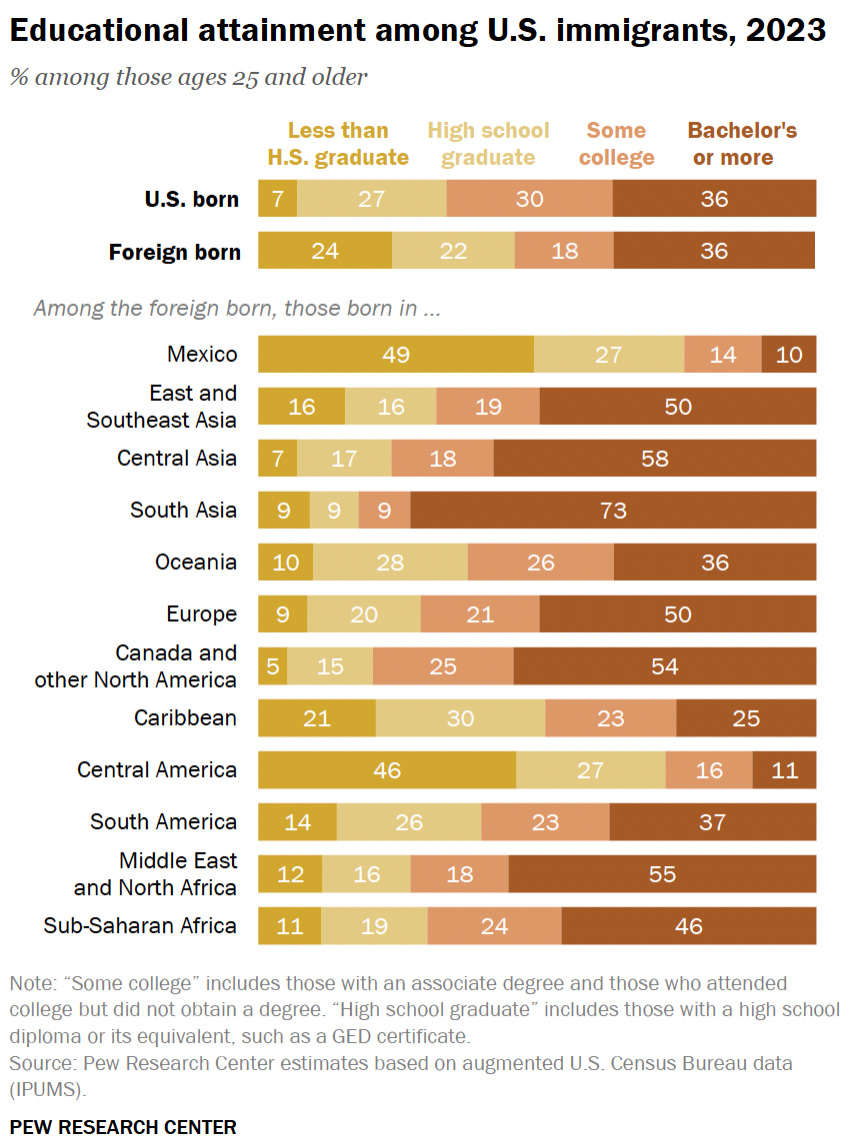
Source: The Pew Research Center (2025)
Keep in mind that the U.S.-born comparison group includes the second generation (children of immigrants), generally high-achieving sub-populations themselves, reflecting a host of factors like selection bias (their parents were likely highly educated at the time they left their countries of origin), to the immigrant paradox where despite facing higher rates of socioeconomic disadvantage, they frequently earn better grades, have better attendance, and show higher levels of motivation, particularly among Asian and African, as well as some Latino, populations. Interestingly, research suggests a trickle effect: greater exposure to immigrant peers correlated with better math and reading scores among U.S.-born students as well.
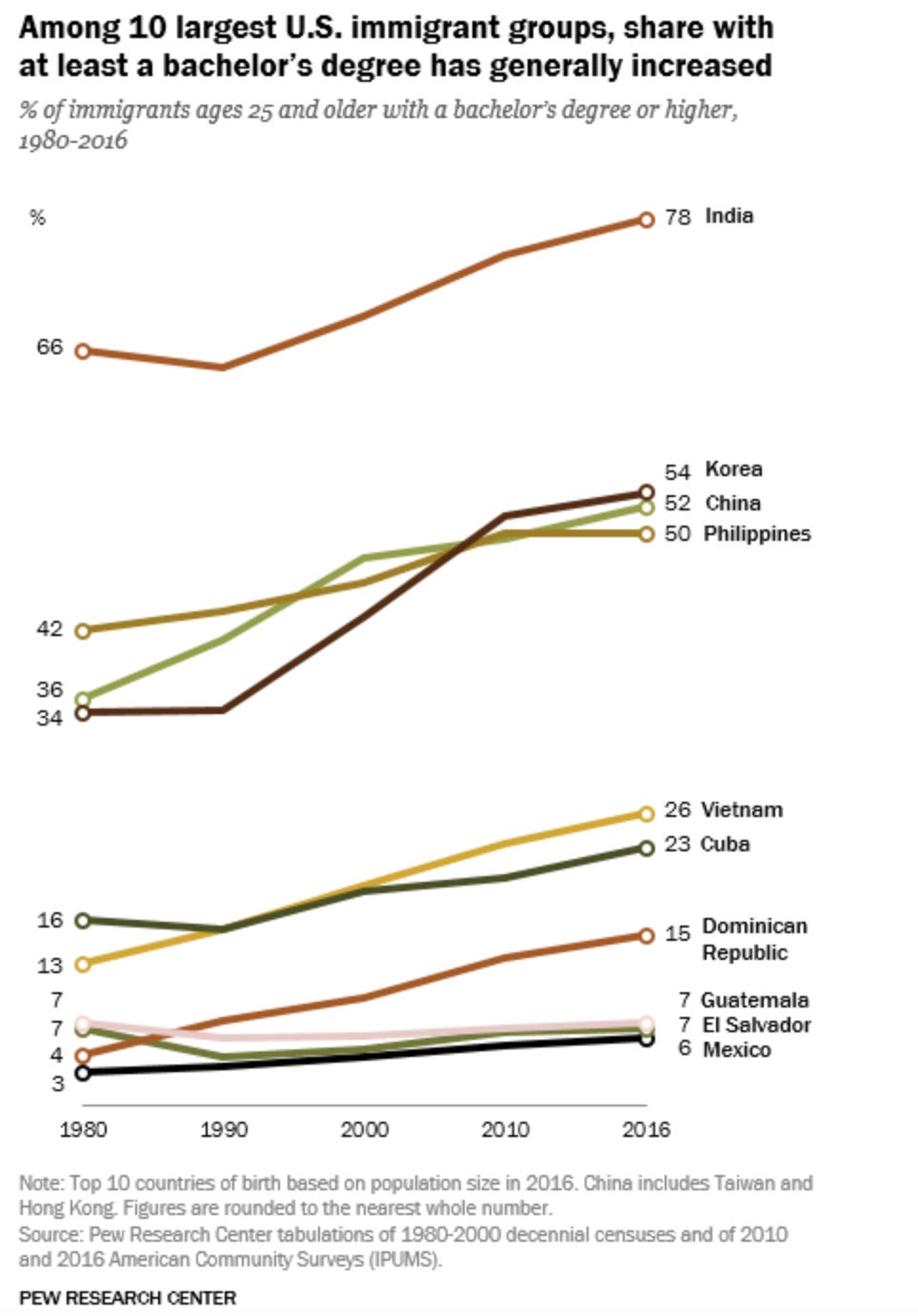
When it comes to immigrants, the share with at least a bachelor’s degree has been steadily rising across geographies:
So, are they taking American jobs?
The idea that immigrants “take” American jobs is one of those deeply held beliefs that feels intuitively correct to many. It’s easy to look at a local job market, see an immigrant worker, and assume that the position they fill is one that would have otherwise gone to a native-born American. However, economists call this the “Lump of Labor” fallacy, and it is a misconception that fundamentally misunderstands how a modern, dynamic economy actually functions.
To understand why this is a myth, we have to stop viewing the economy as a fixed-size cake where every slice given to someone else leaves less for you. In reality, the labor market is far more fluid. When an immigrant enters the workforce, they aren’t just adding to the supply of labor; they are also becoming a consumer. They rent apartments, buy groceries, pay for transportation, and utilize services. This spending ripples through the economy, creating demand for goods and services that requires more hiring. Simultaneously, immigrant entrepreneurship rates are consistently higher than those of native-born citizens, meaning they are frequently the ones creating new employment opportunities rather than simply competing for existing ones.
The relationship between immigrant workers and native-born workers is more often one of complementarity rather than direct replacement. We see this play out in the skill spectrum. On one end, immigrants fill highly specialized STEM roles that allow companies to innovate and expand their workforces. On the other, they fill labor-intensive roles in sectors like agriculture, construction, and caregiving—roles that often experience chronic worker shortages because native-born workers are either unavailable or unwilling to take them at current market wages.
The nuances of this, however, are important. Data from Pew on education from earlier shows that immigrants are not a monolith; they span the entire educational spectrum. While those without a high school diploma may face minor wage competition in very specific, low-skilled sectors, the broader economic data—including recent findings from the Congressional Budget Office—consistently shows that this doesn’t lead to mass displacement.
As net immigration to the U.S. has slowed significantly between late 2025 and early 2026, we haven’t seen a sudden boom in job availability for native-born workers. Quite the opposite: in industries heavily reliant on immigrant labor, the decline in immigration has led to bottlenecks and labor shortages, which in turn have slowed down infrastructure projects and increased the cost of consumer goods.
Ultimately, immigration acts as a vital buffer for the U.S. economy. It fills critical demographic gaps—especially important as the U.S. population ages—and helps maintain the growth required to keep the economy expanding. The narrative of “taking jobs” overlooks the reality that immigrants are, fundamentally, partners in economic growth, contributing more to the tax base and social safety nets than they consume in public services.
So, what’s next?
Ultimately, the story of immigration in the United States is not just about balancing budgets, forecasting GDP growth, or filling labor gaps; it is about the continued evolution of the American identity. While the demographic and economic data demands we recognize immigration as a necessary shock absorber for an aging population—providing the labor force and tax base that keep our essential systems functioning—that perspective alone is insufficient.
Beyond the economic contributions, there is the undeniable vibrancy that defines the nation. Immigrants are an integral part of our social fabric, consistently bringing fresh perspectives, food, music, and innovations that fuel our cultural renewal. From the global fusion that defines our cities to the high-achieving contributions found in our classrooms and neighborhoods, this influx of experiences is exactly what keeps the country dynamic.
Moving forward, the challenge is to move past the rhetoric that paints immigration solely as a crisis or a cost. A forward-looking U.S. must recognize that our economic stability and our cultural vibrancy are two sides of the same coin. Embracing this dual reality—where we rely on the dedication of those who want to build here while celebrating the culture they bring—is the most reliable path toward a resilient, prosperous future.
The Food!
A few friends were asking me cheekily if I was going to make cheeseburgers for the U.S. post. The truth is, when I think of American cuisine, I think of fusion food. So, since Mexico is the largest sending country, we made tacos! 3 versions: one cheeseburger taco (sounds gross, but was the best), a lamb gyro taco with Turkish cacik (mid), and a Korean taco (mid because we forgot to replenish our kimchi, but still good). We had disgusting bottled queso and storebought guacamole on the side. What’s more American than processed food? It was perfect. The kids did research: Kimaya informed us that we have a national flower (a rose), and Eymir did a whole thesis on the underground railroad.


Love this week! Especially in the context of current events it important to look back so we can look forward with hope