In the last few days, there have been news reports about the US considering disengaging from the UN refugee agency (United Nations High Commissioner for Refugees or UNHCR). The Agency’s mandate since 1950 has been to protect and assist millions of people who have been forced to flee their homes due to conflict, violence, or persecution. Editorializing that decision aside, this news comes at an acutely distressing time for the global refugee crisis. In the last week alone, there are reports about ongoing wars, humanitarian crises, stranded boats; all with the dreams of people seeking better lives for themselves and their children. On that latter point, I just read about how Nico Williams’ (part of Spain’s World Cup winning team) mother walked barefoot from Ghana to Spain across the Sahara desert.
But what is a refugee? Are there multiple types? What happens to people who can’t leave? For the last decade, Syria has been the country that was the largest refugee-producing country in the world. It is also now the site of the largest return movement in a generation. I will attempt to explore the refugee crisis in numbers first and then dig into Syria.
A refugee is a legal status, not a descriptor
The 1951 Refugee Convention defines a refugee as someone outside their country of nationality with a well-founded fear of persecution on the following grounds: race, religion, nationality, membership of a particular social group, or political opinion. I really thought it would cover more. For one: there is no legal category for anyone fleeing climate crises and/or emergencies, although the term “climate refugee” sure does get bandied about a lot. It actually has no legal standing, although there is a lot out there challenging exactly that. Another question based on the definition: So, you have to cross an international border, but what happens to the many more people that flee for their lives but just within their own countries? Turns out, they are counted as Internally Displaced People (IDPs), and are covered by guiding principles, rather than a treaty. [That said, two regional treaties widened the door for those regions: the 1969 OAU Convention in Africa and the non-binding 1984 Cartagena Declaration in Latin America both recognize people fleeing generalized violence.]
There are many types of refugees
For the sake of being precise, let’s take a comprehensive look based on latest figures from UNHCR’s Global Trends report (2025):
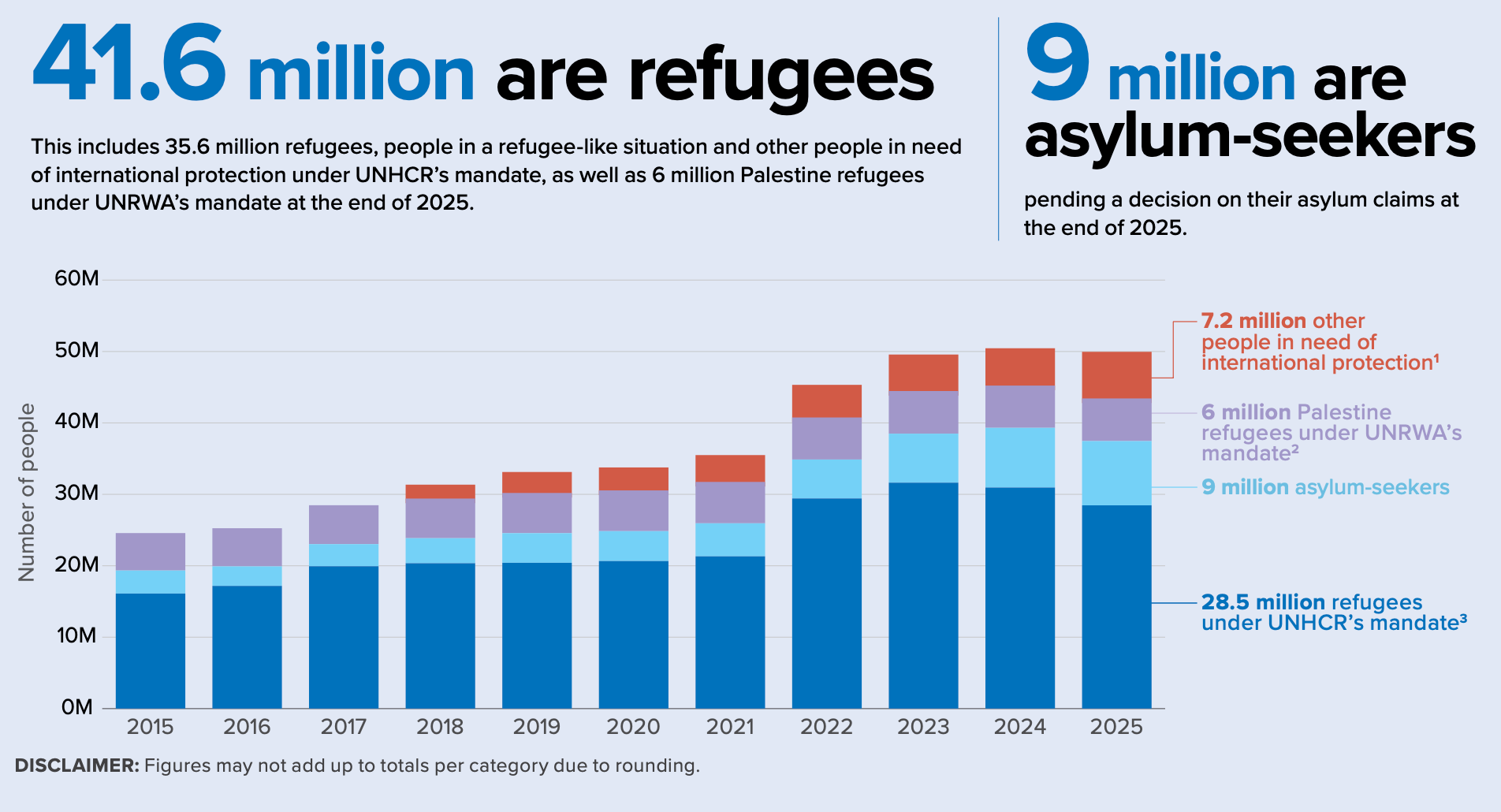
At the end of 2025, there were 41.6 million refugees globally, including refugees under UNHCR’s mandate, people in a refugee-like situation, other people in need of international protection and Palestine refugees under UNRWA’s mandate, as well as 9 million asylum-seekers pending a decision on their asylum claims. [Not pictured: In addition, there were 68.7 million people displaced within their own country due to conflict or violence.]
Some things from the report that stood out to me:
IDPs outnumber refugees by nearly 2 to 1;
Children account for 29% of the world’s population, but 39% of refugees;
The formal pathway to resettlement has narrowed: The number of refugees who arrived through resettlement or sponsorship pathways fell by more than half from the 188,800 recorded in 2024;
Refugees don’t actually travel very far. About 65% live in a country bordering their own, and 68% are hosted in low- and middle-income countries themselves (namely, Colombia, Germany, Türkiye, Uganda, Iran, Chad, and Pakistan).
[A vital-statistics digression, skip if you don’t care about how births get counted (also, how dare you?) Using statistical modelling to fill gaps, UNHCR estimates that more than 2.4 million children were born as refugees between 2018 and 2025 (305,000 a year). Two details make this interesting. First, in 32 host countries the children of refugees born there can acquire that country’s citizenship, so they’re excluded from the estimate entirely. Second, a stated assumption behind the model is that forced displacement changes fertility patterns. So, you can’t just apply origin-country birth rates to refugee populations. There is, in other words, a demography of displacement that is distinct from the demography of the places people left, and we are only beginning to measure it.]
And what happens to the people who can’t leave?
Leaving is expensive. Not only does it take money (in cash!), but it requires documents (and as we have seen, many lack their own birth certificate and other important documents proving their identity, or perhaps can’t find them in a crisis), physical mobility, perhaps even a plan at the other end. So, displacement is really rather selective. It mirrors climate-related migration and traps which we explored in Iran and others. It “traps” older people, people with disabilities, people without papers, women who cannot travel without a male relative, the very poor.
The arithmetic is rather cruel (yet unsurprising): The wealthier and healthier you are, the further you can flee, and the more likely you are to land somewhere that counts you properly and gives you a status. The poorest stay closest to the danger, are more likely to be internally displaced than refugees, and are therefore covered by the weakest legal framework and the smallest budgets.
No country illustrates that better than Syria, where at the end of 2024 roughly 31% of the population was displaced inside the country, the highest share on earth.
The scale of displacement
Syria has been the site of one of the world’s largest forced displacement situations since 2011.
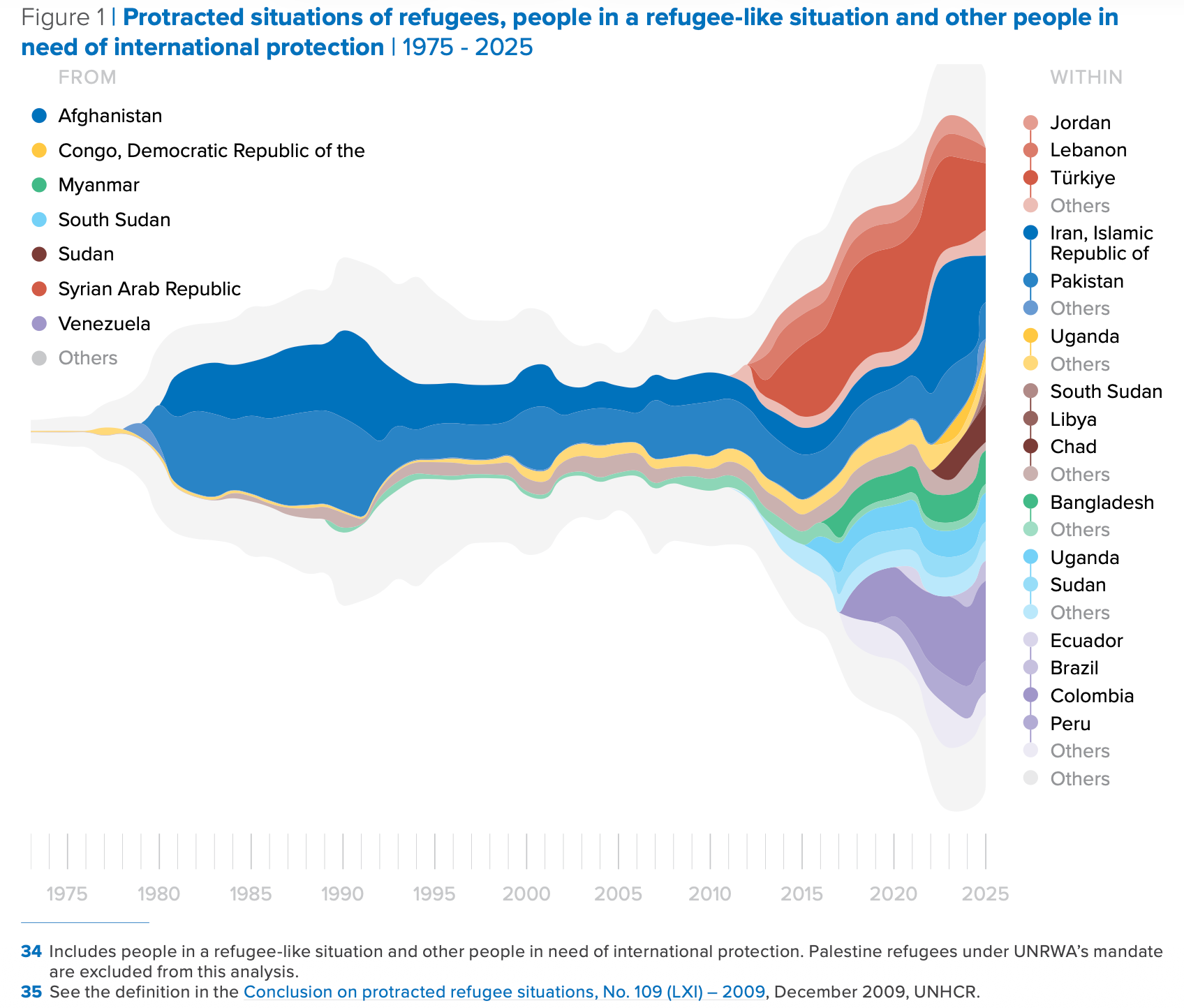
At the end of 2024, there were about 6 million refugees from Syria, which is the largest refugee origin population in the world. Additionally, about 7.4 million were IDPs. They are hosted principally in Türkiye, Lebanon, Jordan, Germany, Iraq, and Egypt. Check out the red below:
This is a great primer on details, some of which I am reproducing below, pardon the copy/paste but saving you the longer read:
The Syrian refugee crisis began in March 2011 as a result of a violent government crackdown on public demonstrations in support of teenagers who were arrested for anti-government graffiti in the southern town of Daraa. The arrests sparked public demonstrations throughout Syria which were violently suppressed by government security forces. The conflict quickly escalated and the country descended into a civil war that forced millions of Syrian families to flee their homes.
The vast majority of refugees who have fled to neighboring countries live in rural and urban settings, with only roughly 5% living in refugee camps. However, living outside refugee camps does not necessarily mean success or stability. More than 70% of Syrian refugees are living in poverty, with limited access to basic services, education or job opportunities and few prospects of returning home.
The situation for Syrian refugees living in neighboring host countries is challenging as well. Economic uncertainty in neighboring countries like Lebanon have pushed Syrians in the country into poverty with more than 90 percent of Syrian refugees reliant on humanitarian assistance to survive. In Jordan, more than 93 percent of Syrian households reported being in debt to cover basic needs. Ninety percent of Syrian refugees living in Türkiye cannot fully cover their monthly expenses or basic needs.
Millions of refugees have lost their livelihoods and are increasingly unable to meet their basic needs - including accessing clean water, electricity, food, medicine and paying rent. The economic situation has also exposed them to multiple protection risks, such as child labor, gender-based violence, early marriage and other forms of exploitation.
The rate of return
According to the UNHCR report, during 2025, roughly 1.3 million Syrians returned from abroad (3x the previous year’s figure), while 2 million Syrian IDPs went back to their places of origin (all totalling 3.3 million Syrians going home in a single year). What changed? The Assad government fell in December 2024, triggering this wave of return.
It’s a searing example that the cost of political crises is often borne by the citizens. In this case, of millions having to leave and then millions returning. The intention to return skyrocketed after the government fell (from under 2% before to nearly 30% in January 2025, but dipped to 14% by the end of that year). Add to that, around 77% say they want to return eventually. UNHCR reads the 2025 decline as shifts in timelines rather than in willingness (people still want to go back, just have recalibrated when). Does that sound familiar? It has echoes in other demographic debates: people want to have more children, but because of constraints, are just moving the timeline to later. Here too, stated intentions do not always predict behavior.
Conditions inside the country
That said, Syria remains one of the largest humanitarian crises in the world. In 2026, about 7 in 10 require humanitarian assistance. Plus, virtually the entire population (90%) is in poverty (up from 33% before the war, for context). 1 in 4 people are unemployed, and this conflict has cost the country roughly $800 billion in GDP. At current growth rates, the UNDP reckons that Syria won’t regain its pre-war GDP until 2080 (!)
Some major bottlenecks from a survey of Syrian refugees living in Egypt, Iraq, Jordan, and Lebanon that again, are not surprising but are worth noting: About 40% of refugees report owning land or property, but only a tenth consider their home habitable. Another survey found that a quarter of Syrian refugee returnees and 15% of IDP returnees lacked at least one key civil document. That said, many civil registry offices themselves are only partially operational. But no papers means no ability to enroll your children in school, no claim on property, and no way to get employment in the formal sector. There is also a widespread presence of unexploded ordnance (UXO, essentially military munitions such as bombs, artillery shells, grenades, and landmines that were deployed but failed to detonate) which continue to pose a grave threat to civilians, particularly children, and disrupts livelihoods.
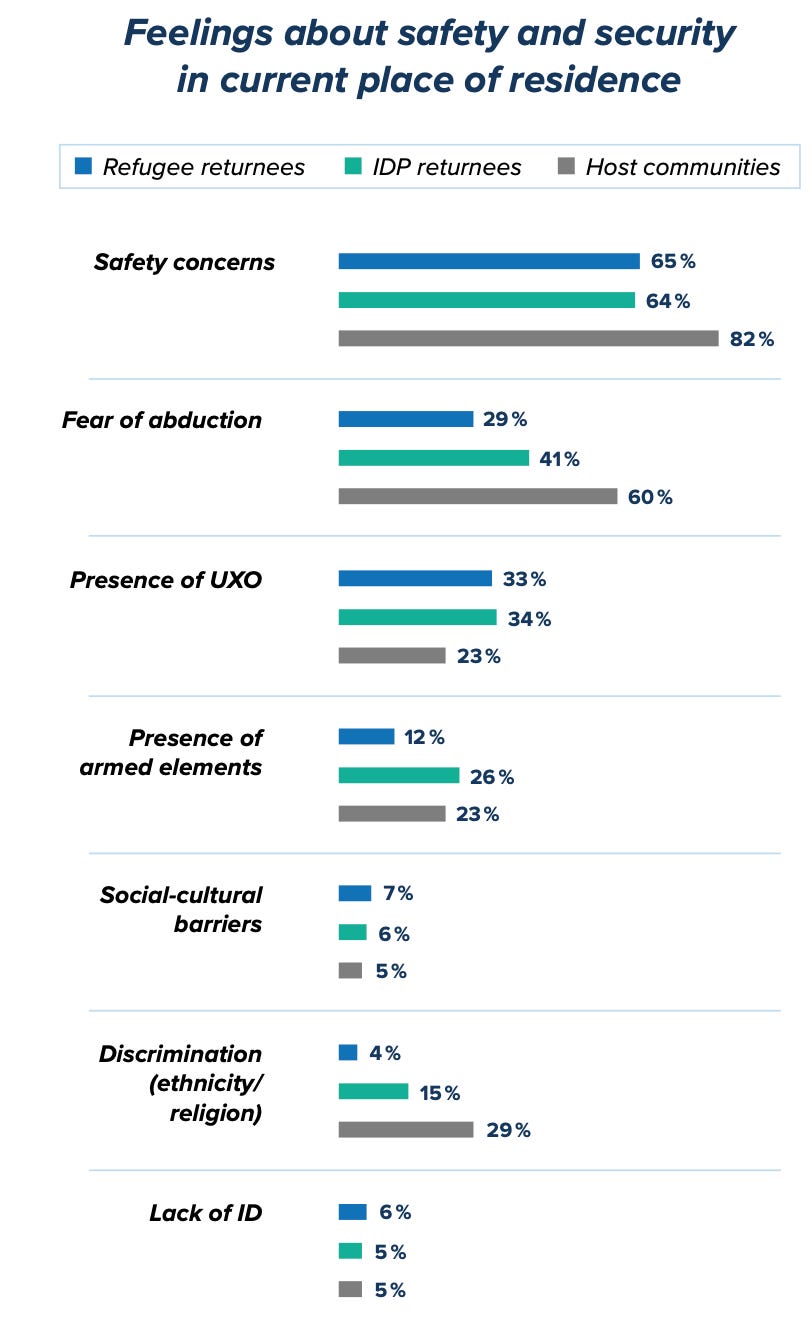
The report also notes that women and girls reported growing restrictions on movement and dress, rising gender-based violence (GBV) risks, and limited participation in social and economic life in certain areas of the country. Children face school dropouts, child labour, language barriers, and heightened psychosocial distress across the country.
Health: WHO monitors Syrian facilities through HeRAMS, a system it has run there since 2013. Its finding: only 57% of hospitals and 37% of primary healthcare centres are fully functional. A UN assessment puts the share of health workers who left during the war at between 50 and 70%. UNICEF’s figure at the start of 2026 is that close to 40 per cent of health facilities remain partly or wholly non-functional. A Relief International assessment (May 2026) found the arrival of returnees was outpacing medical capacity outright: in Deir ez-Zor, 78 per cent of returnees reported that health services were simply unavailable. Meanwhile the EU’s flagship health commitment that month was €14 million to rehabilitate a single hospital in Homs.
Education is worse, and more revealing. Before 2011, primary attendance was an impressive 97%. Today more than 7,000 schools are damaged or destroyed and around 2 million children are out of school. According to UNICEF, one school in three is still unusable (damaged, destroyed, or converted into shelter). Yup. A meaningful share of Syria’s education infrastructure was consumed by the displacement crisis, housing IDPs instead of teaching children. Now those buildings have to educate the returning children of the people who were sheltering in them.
And underneath both sits infrastructure that can’t support either: roughly half of Syrians lack access to clean and safe water, with electricity and sanitation networks degraded across much of the country. UNICEF counts 14.6 million people food insecure at the start of 2026, including 600,000 children under five with wasting.
The demographic point underneath all of this is simple and unforgiving. Return is counted as a solution; it’s the first of the four pathways in UNHCR’s own durable-solutions framework. But a solution in the displacement statistics is a new burden on the health, education, water and civil registry statistics, and nobody is netting the two.
Asylum data from UNHCR states quite plainly that most of the refugee returns in 2025 occurred not because the conditions in Syria were improving. They were not, as shown in the paras above. They were returning because of adverse circumstances in their countries of asylum (getting refused a hearing, resettlement closed, etc). This shows a constraint within a choice, not a complete choice itself.
BTW, The returnee population is not a random sample of the diaspora. If the people going back are overwhelmingly those who never got further than neighboring countries, and the people staying are those who managed to build something farther away, then Syria is reconstructing with a skewed skills distribution with a massive human capital/brain drain. That is a very specific and very hard starting position from which to rebuild a health system, civil service, and more.
Looking ahead
If you read this Substack, you know I love population projection. This is what the UN has for Syria (with the update in 2024, before the fall of the Assad regime, and before the wave of returns started) - yes, population growth, not decline, despite the massive out-migration.
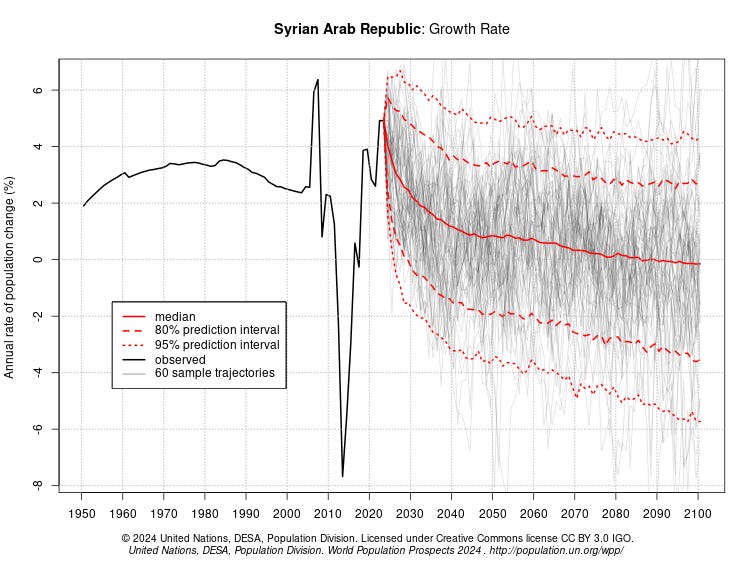
The next revision has been postponed to 2027. So the standard demographic account of Syria will not incorporate the largest population movement in its modern history until roughly three years after that movement began.
The UNHCR’s flagship initiative, 50 by 35, aims to halve by 2035 the number of refugees in protracted displacement who can’t meet their basic needs without humanitarian aid. Its success metric is a poverty measure: whether a refugee’s consumption, excluding aid, falls below the host country’s national poverty line. Measuring that requires refugees to be systematically included in national statistical systems (in household surveys, in poverty assessments, censuses and more).
So the single most ambitious solutions agenda in the refugee system depends entirely on statistical capacity, at precisely the moment statistical capacity is collapsing with major funding cuts: The International Displacement Monitoring Centre (IDMC) reports reduced data availability in 15% of the countries it monitors, three times the 2024 share. The US contributed $868 million in 2025, about a quarter of all contributions (already a drop from $2.06 billion in 2024). That’s the money now in question (read start of this post).
When the 2027 numbers come in lower again, we will have to ask a question with no comfortable answer: are fewer people displaced, or are fewer people counted?
The Food!
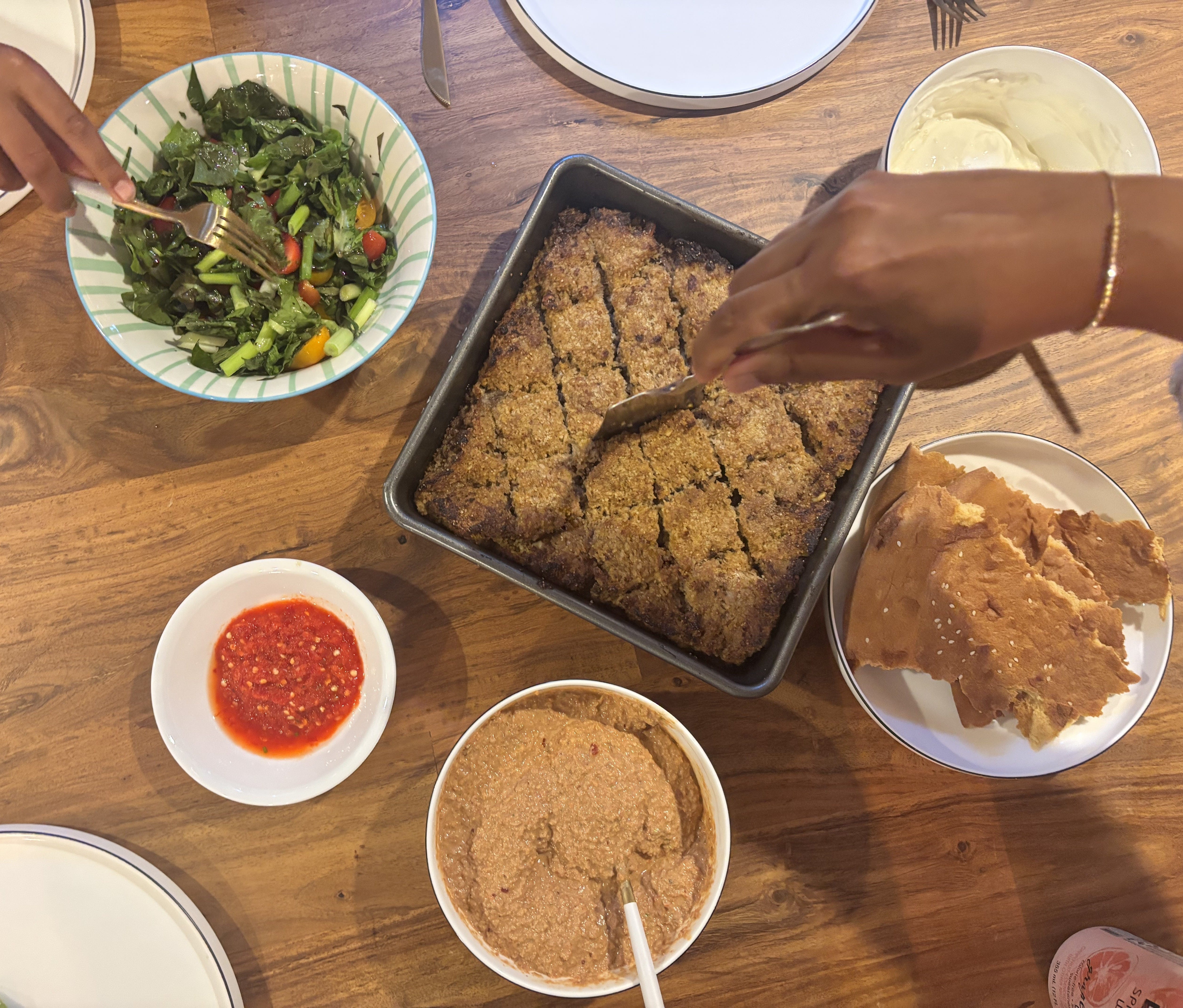
We made Kibbe bil Sanieh (I used a combination of that recipe and this one because I wanted to use those spices) and had that alongside rich garlickey yogurt, salad (thank you, Corkers for the greens), bread, and muhammara. Kimaya has been home all week, so worked on a watercolor flag of Syria (fun fact: the flag changed after the Assad regime), and we danced our hearts out to Omar Suleyman’s jams.